
No, if you provide pro bono therapy services, you can’t write them off your taxes using your typical session cost.
For example, if you charge $100 per session and you provide three sessions of therapy on a pro bono basis, you cannot deduct the would-be $300 fee from your tax bill.
However, depending on how you volunteered your time, and for whom, you may be able to write off costs you incurred in the course of doing so.
Here’s a short, straight-to-the-point rundown of pro bono tax write offs for therapists.
Get your 2026 taxes handled
Join Heard by December 31 for up to $3,227 in value and an on-time 2026 tax return. Book a free consult to learn more.
Book a free consultRequirements for writing off pro bono therapy expenses
The IRS is fairly strict about how businesses are able to write off charitable deductions. For pro bono work, in order to write off anything at all, you need to meet the following requirements.
The work you do is for a 501(c)(3) organization
Generally, if you provide pro bono therapy services to an individual or group, you typically can’t write off the value of the services provided or any of the expenses you incurred in the course of doing so.
The exception would be if you provided therapy services for a “qualified organization,” as defined by the IRS under Internal Revenue Code 501(c)(3) and includes many charities, churches and government bodies.
For instance, if you volunteered your time as a therapist at a youth shelter that is a 501(c)(3) organization, and provided your services on behalf of the shelter, you would be able to write off expenses you incurred.
You must provide services related to your role as a therapist that are “necessary” and “primarily” benefit to the organization
In order to write off expenses related to doing pro bono work, your therapy-related expertise must be:
- Necessary for providing the service and
- Be for the primary benefit of the organization, not you.
You can’t clean dishes two hours per week at a soup kitchen, and write off expenses related to doing so on the tax return for your therapy practice. The services you provide must be ones you’d typically charge for in the course of running your practice.
In this case, at least, virtue must be its own reward.
You can only deduct your incurred expenses
If you don’t incur expenses in the course of doing pro bono work, there are no tax write-offs to include on your tax return for your pro bono activity. You can’t write off the value of your time.
If you purchase equipment or any other professional materials in the course of providing pro bono work, the equipment must be given to the organization. You cannot keep it.
This rule is meant to prevent businesses from writing off large purchases in the course of doing pro bono work (e.g. “In order to deliver this one hour pro bono online lecture, I needed to buy a new Macbook”).
Determining the expenses you can write off for pro bono therapy
You can write off any ordinary and necessary expense you incur in the course of providing pro bono work on your business’ tax return.
“Ordinary” means it’s an expense you’d typically expect to incur, according to the standards of your industry. Car mileage is ordinary. Limo fees are not.
“Necessary” means you had no choice but to incur the expense. Again, car mileage typically applies. Car mileage for three hours of errands you run en route to volunteering for a charitable organization located fifteen minutes away does not.
Keep in mind, “ordinary and necessary” doesn’t mean “indispensable.” Conceivably, you could ride a bicycle to your pro bono appointment, and you wouldn’t have to write off any mileage. But, unless the charity is located just a few blocks away, it’s reasonable to drive your car instead.
Some typical expenses you may write off in the course of providing pro bono work:
- Mileage
- Other travel costs (meals and lodging)
- Therapeutic toys and books (see Rule #4 in the previous section)
- Supplies for group activities (e.g. name tags, craft supplies)
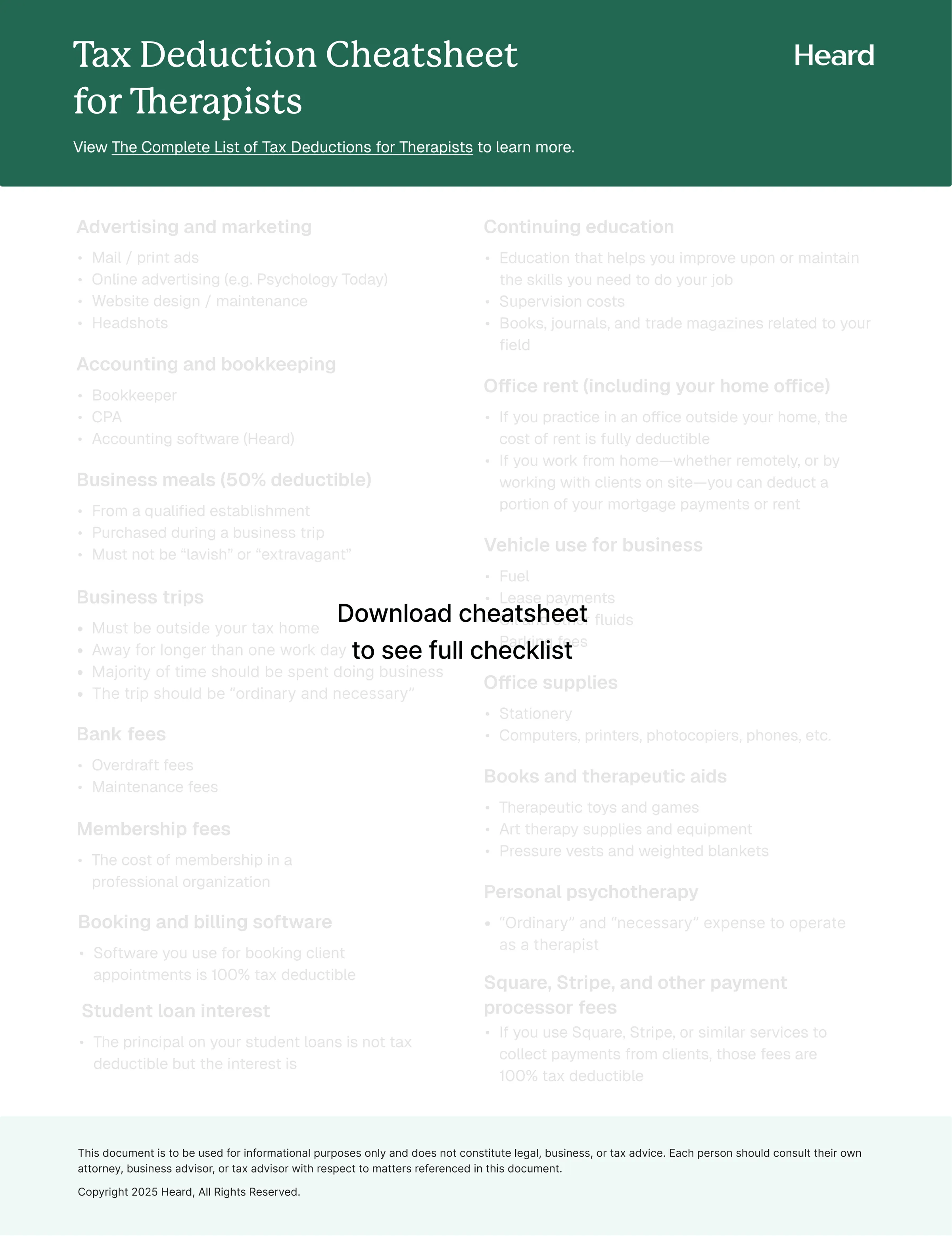
For more ideas, check out our complete list of tax deductions for therapists.
Get your 2026 taxes handled
Join Heard by December 31 for up to $3,227 in value and an on-time 2026 tax return. Book a free consult to learn more.
Book a free consultHow do you write off pro bono expenses on your tax return?
If you are a sole proprietor, or an LLC filing as a sole proprietor, you write off pro bono expenses on Schedule C of Form 1040.
If you are a single-member S corporation, you write them off on Form 1120S, and if you are part of a partnership, you use Form 1065.
Frequently asked questions
Can therapists deduct the value of pro bono therapy sessions?
No. You can't write off the fee you would have charged or the value of your time. For example, three pro bono sessions at $100 each don't give you a $300 deduction.
When can therapists write off expenses from pro bono work?
You may be able to deduct expenses if you provide services for a qualified 501(c)(3) organization, like many charities, churches, and government bodies. Your therapy expertise must be necessary for the service, and the work must primarily benefit the organization, not you.
What pro bono expenses can therapists write off?
You can write off ordinary and necessary expenses you incur while doing the work, such as mileage, other travel costs like meals and lodging, therapeutic toys and books, and supplies for group activities. If you buy equipment or materials for the work, you must give them to the organization.
Where do therapists report pro bono expenses on their tax return?
Sole proprietors, and LLCs filing as sole proprietors, use Schedule C of Form 1040. Single-member S corporations use Form 1120S, and partnerships use Form 1065.
—
Pro bono work is a great way to help others and connect with members of your community—but it typically doesn’t result in huge tax write-offs for therapists. To find more effective ways of lowering your tax bill, check out our complete guide to tax deductions for therapists.
Visit our Therapist Tax Center and Tax Deductions for Therapists Hub for everything you need to know about taxes as a practice owner. If you're just starting out, here's everything you need to know about How to Start a Private Practice as a Therapist.
This post is to be used for informational purposes only and does not constitute legal, business, or tax advice. Each person should consult his or her own attorney, business advisor, or tax advisor with respect to matters referenced in this post.
Bryce Warnes is a West Coast writer specializing in small business finances.
Discover more. Get our newsletter.
Get free articles, guides, and tools developed by our experts to help you understand and manage your private practice finances.
Thank you for signing up. Keep an eye out for your first newsletter arriving soon!