In times of economic uncertainty, your therapy practice’s best defense is the work you’ve already put into building it.
By planning in advance, developing good habits, and putting backup systems in place, you give your practice a better chance of weathering the storm. The important thing is to start preparing now.
Here are seven steps you can take to protect your practice in uncertain times.
- Build an emergency fund
When you have a well-provisioned emergency fund, you’re less likely to rely on loans or other forms of credit when money is tight.
Three important guidelines:
- Set up regular contributions. The aim is for your fund to steadily grow. Make contributions to it part of your monthly budget.
- Create clear rules for how you use the money. Put down in writing when it’s appropriate to draw on emergency funds, and when it’s not.
- Earn interest if you can. A certificate of deposit (CD) account limits ready access to your savings, but helps them grow incrementally over time.
Further reading: How to Build an Emergency Fund as a Therapist.
- Open a business line of credit
Relying on credit to cover your expenses should be a last resort. But it’s better to have credit available than not to have it at all. That way you can cover unexpected revenue dips and gaps in cash flow without touching your personal savings.
A line of credit is preferable to:
- A credit card. The interest rates are lower, making it easier to keep your debt burden under control.
- A loan. A line of credit had no fixed repayment terms, and no restrictions on how you may use the funds.
You can open a line of credit with your banking institution and leave it unused until the situation demands it. Or you can use your line of credit to make recurring payments which you then immediately pay off—so that, rather than sitting idle, it helps you build your credit score.
Further reading: The Complete Guide to Credit for Therapists
- Plan for seasonality
Depending on your practice and your typical clientele, you may see cyclical changes in revenue.
For instance, some therapy practices get a wave of incoming clients each January as people make good on their New Year’s resolutions to improve their mental health. Others see their income decrease during summer as patients go on vacation and put a pause on regular appointments.
Analyze past profit and loss statements (P&Ls) and work schedules to spot these changes. Then treat seasonality as a training ground for protecting against economic uncertainty.
The good habits that help your business manage seasonality—like projecting month-by-month income, setting aside savings, and speeding up cash flow—also apply in general to protecting your practice. You can expand upon those to create systems that prepare your practice for larger, more protracted changes.
- Diversify income streams
The more diverse your income streams, the more resilient your practice.
For instance, when money is tight, cash pay clients may churn. That makes you vulnerable if your client list is exclusively cash pay. Becoming credentialed with insurance panels and balancing cash pay clients with clients who have coverage helps minimize impact.
Other revenue streams to consider:
- Online workshops and webinars
- Speaking engagements
- Supervision
- Consulting
- Group therapy
- Coaching
- Diagnostic assessments
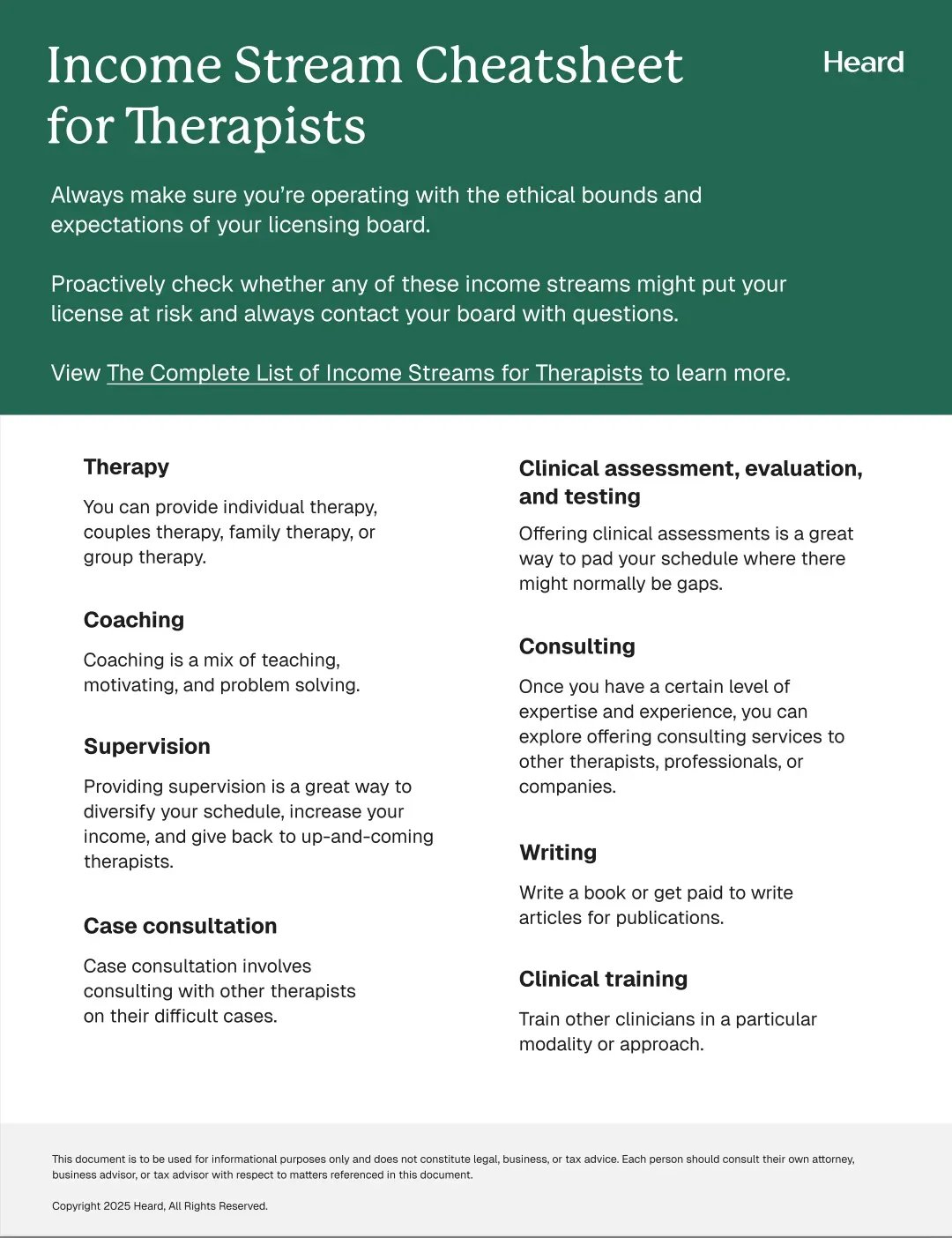
Further reading: The Complete List of Income Streams for Therapists.
- Strengthen client relationships
Strong, trusting relationships with your clients not only improve treatment outcomes, but reduce the likelihood clients will churn even when their budgets are tight.
You can strengthen your relationships by:
- Offering flexible fees
- Providing out-of-session support
- Providing client-only newsletters, workshops, and learning materials
The more they value you and your services, the more likely clients will stick around.
Further reading: Managing a Therapy Practice During Economic Uncertainty
- Build a responsive budget
Your practice’s budget should be designed to adapt to changes in revenue and expenses. A budget that regularly changes in order to meet your needs will help you stay on track with managing your finances and covering expenses even when earnings take a hit.
Some flexible budgeting methods to consider:
- Incremental budgeting sets a new budget each month, basing changes on the performance of the prior month’s budget
- Zero base budgeting (ZBB) requires you to justify each expense and ensure funds are used in the most effective way possible
- Profit first is a fully-fledged financial management system, but its budgeting methods help to guarantee you earn a sustainable profit while minimizing expenses
Further reading: How to Build a Budget for Your Therapy Practice (for getting started), The Complete Budgeting Guide for Therapists (for more advanced methods, and for taking your personal budget into account)
- Learn to rely on reporting
Financial reports—your monthly P&L and balance sheet—help you track how money enters and leaves your business, and how much you have on hand to cover expenses. Without these reports, it’s impossible to make informed financial decisions and stop small problems before they become big ones.
Putting in place a professional bookkeeping solution, complete with financial reports, protects you in the long term while helping you make smart day-to-day decisions.
Further reading: The Complete Guide to Bookkeeping for Therapists
Frequently asked questions
How can therapists protect their practice during economic uncertainty?
Plan ahead, build good habits, and put backup systems in place. Seven steps that help are building an emergency fund, opening a business line of credit, planning for seasonality, diversifying income, strengthening client relationships, building a responsive budget, and relying on financial reports.
How should a therapist build an emergency fund for their practice?
Make regular contributions part of your monthly budget so the fund grows steadily. Write down clear rules for when it's okay to use the money, and earn interest if you can, for example with a certificate of deposit (CD).
Why open a business line of credit for a therapy practice?
Having credit available lets you cover unexpected revenue dips and cash flow gaps without touching your personal savings. A line of credit has lower interest rates than a credit card, and unlike a loan it has no fixed repayment terms or limits on how you use the funds.
What income streams can therapists add to make their practice more resilient?
Balancing cash pay clients with insured clients can help, since cash pay clients may leave when money is tight. Other options include online workshops and webinars, speaking, supervision, consulting, group therapy, coaching, and diagnostic assessments.
How can therapists keep clients from leaving when budgets are tight?
Strong, trusting relationships make clients less likely to leave. You can offer flexible fees, provide out-of-session support, and share client-only newsletters, workshops, and learning materials.
—
For a deeper dive, including step-by-step guides to protecting your practice, check out Managing a Therapy Practice During Economic Uncertainty
This post is to be used for informational purposes only and does not constitute legal, business, or tax advice. Each person should consult their own attorney, business advisor, or tax advisor with respect to matters referenced in this post.
Bryce Warnes is a West Coast writer specializing in small business finances.
Discover more. Get our newsletter.
Get free articles, guides, and tools developed by our experts to help you understand and manage your private practice finances.
Thank you for signing up. Keep an eye out for your first newsletter arriving soon!