Key Takeaways:
- Sole proprietors do not need an EIN to operate
- You need an EIN to form a business entity (LLC, S corp, etc.)
- Sole props need an EIN to open a business bank account, hire employees, or apply for a business loan or line of credit
Your employer identification number (EIN)—also known as a “federal employee identification number” or “federal tax identification number”—is a nine digit number the IRS uses to track your business for tax purposes.
Think of it as a social security number for your business.
Don’t be fooled by the word “employer.” Any therapy practice can apply for an EIN, regardless of whether it has employees.
Here’s an overview of what an EIN does, how to get one, and how to decide whether your practice needs an EIN.
Need help setting up your business structure?
When the timing is right, Heard discusses setting up or changing your business structure—and handles the filing for you. Book a free consult to learn more.
Book a free consultDo you need an EIN for your therapy practice?
If you are a sole proprietor, you don’t need an EIN. You can use your personal SSN to identify your business—since, for tax purposes, you and your business are identical.
If you plan to form a partnership, register an LLC, or elect S corporations status, you're required by law to get an EIN.
Even if you’re a sole proprietor with no plans to form a separate business entity, you need an EIN in order to:
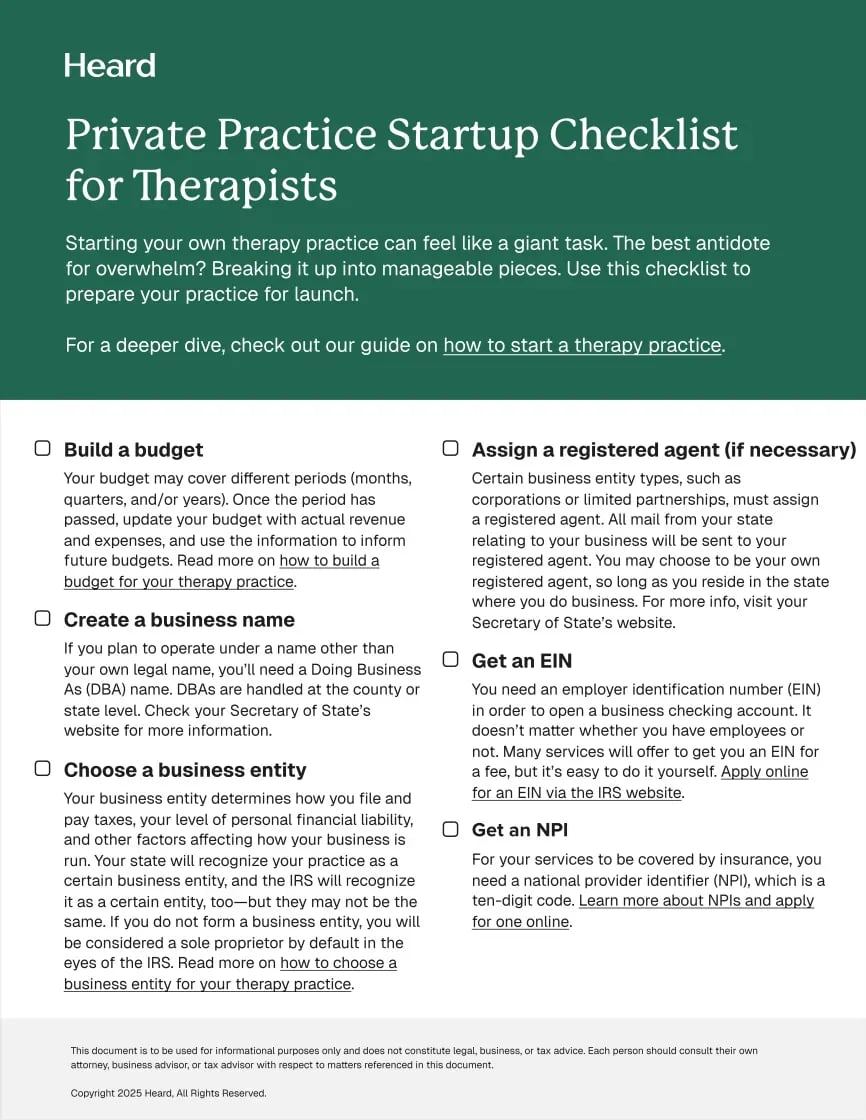
- Open a business bank account
- Apply for a business loan or line of credit
- Hire employees
- Have a Keogh or Solo 401(k) retirement plan
- File for bankruptcy
Depending on your location, your state or local government may require you to have an EIN in order to apply for business permits and licenses.
| Business move | EIN required? |
|---|---|
| Operating as a sole proprietor | No |
| Opening a business checking account | Yes |
| Applying for a business loan or line of credit | Yes |
| Hiring employees | Yes |
| Registering a Keogh or Solo 401(k) retirement plan | Yes |
| Registering a SEP IRA (no employees) | No |
| Forming an LLC, S corporation, partnership, or other business entity | Yes |
Need help setting up your business structure?
When the timing is right, Heard discusses setting up or changing your business structure—and handles the filing for you. Book a free consult to learn more.
Book a free consultDo you need an EIN for HIPAA?
Strictly speaking, you do not need an EIN in order to remain HIPAA compliant. If you're wondering what an EIN is in medical billing, it's rarely used directly — your national provider identification (NPI) is what identifies you on claims.
In the context of HIPAA, An EIN only really comes into play when you need to identify yourself as an employer—for instance, when administering group employee benefits.
For the purpose of transmitting clients’ protected health information (PHI), you typically use NPI to identify yourself and your practice. Some practices also call this a “practice ID” or “tax ID.”
Reasons to get an EIN as a therapist
Even if you don’t require an EIN, getting one can benefit you and your practice.
An EIN can:
- Reduce the risk of identity theft. As a sole proprietor, you may need to provide your SSN to identify yourself on public-facing documents. Using an EIN instead protects your SSN.
- Help establish business credit. An EIN allows you to build a business credit history distinct from your personal credit. Building good credit for your practice helps you borrow money and get favorable terms in the future.
- Establish the validity of your practice. Opening your own therapy practice with its own EIN sets a boundary between your professional and personal lives. It makes your practice more “legitimate” both in your own eyes and in the eyes of financial institutions and other businesses.
How to apply for an EIN as a therapist
Applying for an EIN is free and takes about 15 minutes. The fastest and easiest way to obtain an EIN is to apply online.
Here’s how to do it:
- Choose the right time. Online applications are open 6am – 1am EST weekdays, 6am – 9pm Saturdays, and 6am – 12am Sundays.
- Prepare your information in advance. You’ll need your business entity type, your business address, your reason for applying (eg. banking purposes, new business entity), and your SSN.
- Visit the online application portal. Register for an EIN here.
- Complete the application. Completing the application is a matter of selecting from multiple choice questions and filling out required fields.
- Submit the application and wait for your EIN. In most cases, you will receive your new EIN on the next business day.
Summary:
- Sole proprietors do not need an EIN, but it’s required to open a business bank account, build business credit, and open certain types of retirement savings accounts
- Any business entity besides a sole proprietorship requires an EIN in order to operate
- For HIPAA purposes, your practice will usually use its NPI, not its EIN, to identify itself
- An EIN can help prevent identity theft by saving you from using your SSN on public-facing documents
- Applying for an EIN online iis free and takes 15 minutes
Frequently asked questions
What is an EIN for a therapy practice?
An employer identification number (EIN) is a nine digit number the IRS uses to track your business for tax purposes, like a social security number for your practice. Any therapy practice can apply for one, whether or not it has employees.
Do sole proprietor therapists need an EIN?
Not to operate, since you can use your SSN. But you'll need an EIN to open a business bank account, apply for a business loan or line of credit, hire employees, or have a Keogh or Solo 401(k). If you form an LLC, a partnership, or elect S corp status, an EIN is required by law.
Do therapists need an EIN to be HIPAA compliant?
No. For sending protected health information and billing claims, you typically use your NPI to identify yourself and your practice. An EIN only comes into play under HIPAA when you need to identify yourself as an employer, like when administering group employee benefits.
Why should therapists get an EIN even if they don't need one?
Using an EIN instead of your SSN on public-facing documents lowers your risk of identity theft. It also helps you build business credit separate from your personal credit and sets a clear line between your practice and your personal life.
How do therapists apply for an EIN?
Apply online with the IRS. It's free and takes about 15 minutes, and you'll need your business entity type, business address, reason for applying, and SSN. In most cases, you'll get your EIN the next business day.
—
Visit our Therapist Tax Center and Tax Deductions for Therapists Hub for everything you need to know about taxes as a practice owner. If you're just starting out, here's everything you need to know about How to Start a Private Practice as a Therapist.
This post is to be used for informational purposes only and does not constitute legal, business, or tax advice. Each person should consult their own attorney, business advisor, or tax advisor with respect to matters referenced in this post.
Discover more. Get our newsletter.
Get free articles, guides, and tools developed by our experts to help you understand and manage your private practice finances.
Thank you for signing up. Keep an eye out for your first newsletter arriving soon!