
An S corp may start to make sense for a therapist once the practice earns roughly $80,000 to $100,000 a year in profit, and it tends to pay off most clearly past about $100,000. Below that range, the added costs of payroll, a separate business tax return and state fees can eat up most or all of the payroll tax you save.
Where you land in that range depends on your numbers: the salary you'd need to pay yourself, your state's fees and taxes, and how steady your income is. Below, you'll find an illustrative example, the costs to plan for, the rules in California and New York, and the deadlines that decide when an election can take effect. For the entity side (LLC, PLLC and when you're allowed to elect), see when are you S corp eligible.
Get your 2026 taxes handled
Join Heard by December 31 for up to $3,227 in value and an on-time 2026 tax return. Book a free consult to learn more.
Book a free consultAn illustrative example at three profit levels
The example below is illustrative only. It compares federal self-employment tax as a sole proprietor with payroll taxes (FICA) on a hypothetical S corp salary, using 2026 rates. Your own salary, costs and taxes may look very different.
As a sole proprietor, self-employment tax is generally 15.3% of 92.35% of your net earnings. As an S corp, the 15.3% payroll tax applies to the salary you pay yourself, split between the S corp and your paycheck. Distributions on top of that salary aren't subject to payroll tax.
| Illustrative only | $60,000 profit | $100,000 profit | $150,000 profit |
|---|---|---|---|
| Sole prop self-employment tax (15.3% × 92.35% of profit) | ~$8,480 | ~$14,130 | ~$21,190 |
| Hypothetical S corp salary | $40,000 | $55,000 | $70,000 |
| Payroll tax on that salary (15.3%) | $6,120 | $8,415 | $10,710 |
| Payroll tax difference | ~$2,360 | ~$5,715 | ~$10,485 |
| Hypothetical added S corp costs (payroll service, business tax return) | ~$2,000 | ~$2,000 | ~$2,000 |
| What may be left | ~$360 | ~$3,715 | ~$8,485 |
In this example, the S corp barely breaks even at $60,000 in profit, may come out a few thousand dollars ahead at $100,000, and may come out further ahead at $150,000. That pattern is why Heard talks about a range rather than a single number. A higher reasonable salary, state taxes (like California's) or higher accounting fees push the break-even point up.
For context on the margin side of the equation, sole proprietor therapists kept a 72.1% net margin in 2025, compared with 64.4% for S corp practices, according to Heard's 2025 income report. S corp expenses rose 11.2% year over year, so the tax savings need to clear those added costs.
Want a rough estimate at your own income? Try Heard's S corp calculator.
A quick refresher on S corporations
By default, when you go into business for yourself, the IRS considers you a sole proprietor. You report all your business's revenue and deductible expenses on your personal tax return. You pay income tax on your profit based on your personal tax bracket, plus self-employment tax.
When you elect S corporation status, you become a shareholder in your own corporation. (If you're the only shareholder, you hold 100% of the shares.)
You still pay income tax on the S corp's profit, but not self-employment tax. Only the wages you pay yourself as an employee of your own S corp are subject to payroll taxes.
You can also take money out of your S corp as shareholder distributions, which aren't subject to payroll taxes, and in some cases as tax-free benefits like a health reimbursement arrangement.
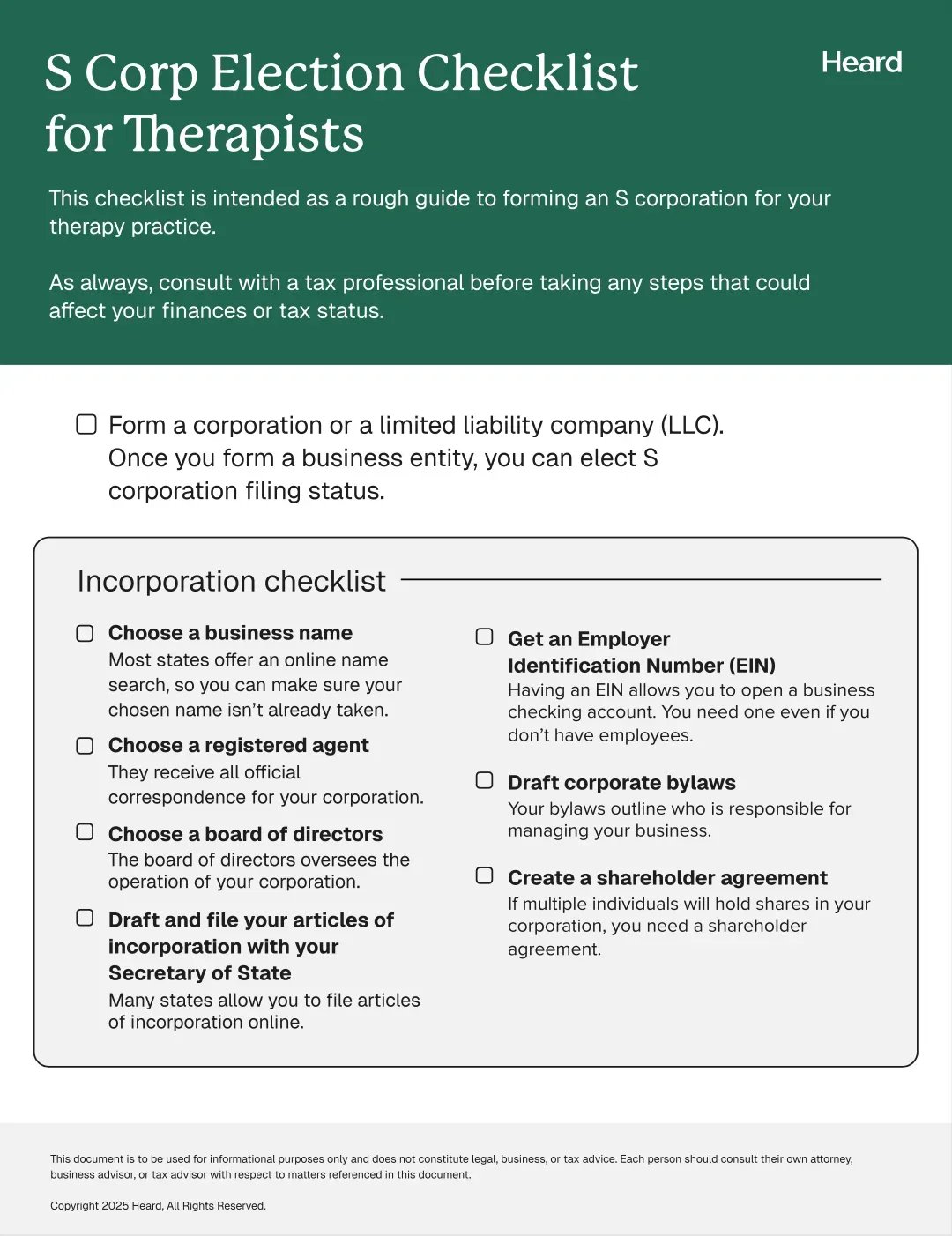
Most therapy practices that elect S corp status first register as limited liability companies (LLCs or PLLCs) in the states where they do business. Then they elect S corp status by filing IRS Form 2553.
If you're new to the S corp concept, check out our Complete Guide to S Corporations for Therapists.
You'll need to pay yourself a reasonable salary
The S corp savings come from the gap between your profit and your salary, so the salary is the biggest lever in the math. The IRS says S corporations must pay a shareholder-employee reasonable compensation for their services before taking non-wage distributions.
The IRS doesn't publish a formula or a safe-harbor percentage. It looks at factors like your training and experience, your duties, the hours you work, and what comparable businesses pay for similar services. For a therapist, that usually means a salary in line with what a practice would pay a clinician with your license and caseload.
That's also why the threshold is a range. A therapist who needs a higher reasonable salary has a smaller gap to save on. Our guide to calculating a reasonable salary as a therapist walks through the research.
Once you're an S corp, you also need to run payroll for yourself: regular paychecks with income tax and FICA withheld, payroll tax filings, and a W-2 at year end.
You can afford the extra costs
Electing and keeping S corp status takes extra services, like bookkeeping and payroll, that cost money to outsource. It may also bring extra fees or taxes at the state level.
Before electing S corp status, add up all the fees involved and make sure:
- You can afford them upfront, in the case of one-time payments, and
- It makes long-term financial sense (you aren't paying more in fees than you're saving in taxes)
For a full breakdown, see how much it costs therapists to switch to an S corporation. Here's an overview of the extra costs:
One-time accounting fees
If you're comfortable with IRS forms, you can form an LLC and elect S corp status on your own.
Otherwise, plan to hire an accountant. Working with an accountant, the cost of converting your sole prop into an S corp may run around $1,000, depending on who you hire and where you live.
A separate business tax return
As an S corp, your practice files its own business tax return each year, in addition to your personal return. For a calendar-year S corp, that return is generally due March 15.
S corp returns tend to get more scrutiny than sole proprietor returns, especially around owner salaries, so most owners hire an accountant to prepare them.
An accountant can also help you set a reasonable salary and plan shareholder distributions from your S corp.
For these services, expect to pay at least a few hundred dollars a year, and often more.
Bookkeeping
You can't file taxes accurately without accurate, up-to-date books.
As a sole proprietor, you may be able to get by with a spreadsheet. With an S corp, payroll, distributions and a business return make DIY books much harder to keep right.
The cost of hiring a bookkeeper varies widely. For more info, learn why bookkeeping is important for therapists.
LLC, PLLC, or other entity registration
To elect S corp status, you typically need to register as a business entity at the state level.
Not every state lets therapists form a regular LLC. In some states, therapists and others in licensed fields must form professional LLCs (PLLCs) or professional corporations. There's usually a filing fee, and some states charge annual report fees too. Our complete guide to LLCs and PLLCs for therapists covers the rules by state.
Local and state taxes
Depending on where you practice, an S corp may owe state or local taxes that a sole proprietorship doesn't. California and New York are two common examples, covered below. Depending on local laws, you may also owe fees at the city or county level.
Insurance
Some types of business insurance for your therapy practice may change their rates when your business structure changes. States also have different rules about which types of insurance a registered business entity needs.
Payroll
Income tax and FICA withholding, payroll filings and payments add a layer to your month-to-month bookkeeping, even if you're the only employee on payroll.
You'll also need some form of employment agreement to make it official.
Learn how to set up payroll for your therapy practice. Many therapy practices outsource this work to a payroll provider. The cost varies widely. As an example, for a company with just one employee on payroll, Heard's partner Gusto charges $46 per month for payroll and benefits integration.
California and New York have extra rules
California. California law doesn't allow an LLC to provide professional services that require a state license, so licensed therapists there generally use a professional corporation instead of an LLC. California S corporations generally pay a 1.5% state tax on net income, with an $800 minimum franchise tax each year. New corporations are generally exempt from the minimum tax in their first taxable year. Check with your licensing board on any registration it requires for a professional corporation.
New York. Licensed professionals in New York generally form a professional service LLC (PLLC) or a professional corporation, not a regular LLC. A new PLLC must also publish a notice of its formation in two newspapers within 120 days, which can add to startup costs. New York doesn't automatically treat a federal S corp as a New York S corp: you file a separate state election (Form CT-6), or the practice pays New York corporate franchise tax like a C corporation. New York City doesn't recognize S corp status, so a practice in the city may owe the city's General Corporation Tax.
In both states, these extra costs can push your break-even point higher than in the example above.
Get your 2026 taxes handled
Join Heard by December 31 for up to $3,227 in value and an on-time 2026 tax return. Book a free consult to learn more.
Book a free consultYou have the cash flow to cover it
Cash flow is how quickly money comes into your practice compared with when it has to go out. Once you elect S corp status, your cash flow needs are likely to change.
You now have new expenses to cover, like your own salary, on a fixed schedule. When your S corp doesn't have the cash to cover them, you'll need to dip into savings or rely on credit.
Sole prop vs. S corp cash flow requirements: an example
Here's a quick comparison showing how cash flow requirements may differ depending on whether your business is a sole prop or an S corp.
Sole proprietorship
Suppose your monthly recurring expenses look like this:
| Office rent | $1,400 |
|---|---|
| Utilities (phone, electricity) | $200 |
| Owner’s draw | $3,400 |
| Total | $5,000 |
You can technically withdraw money from your business checking account any time you need it for personal use. For the sake of keeping your bookkeeping organized, it's best to set an owner's draw: a set amount you withdraw every month to pay yourself.
With this (simplified) arrangement, you need $5,000 in positive cash flow each month to cover operating expenses.
S corporation
For an S corporation with the same office expenses, paying the owner the same amount as salary, monthly expenses would look like this:
| Rent | $1,400 |
|---|---|
| Utilities (phone, electricity) | $200 |
| Salary | $3,400 |
| FICA contribution | $260 |
| Payroll service (Gusto) | $46 |
| Total | $5,286 |
Turning that $3,400 per month from owner's draw into salary, and outsourcing your payroll, raises your monthly cash needs by $286.
That may not seem like much. But there's an important difference between owner's draw and salary: your owner's draw is optional. Your salary is not.
Suppose a few clients miss their appointments one month, and your revenue comes in $300 short. As a sole prop, you can take a $300 smaller draw that month. There's no rule forcing you to take the same draw every month.
Now suppose you're $300 short and it's payday. You can't just cut your salary. You may be able to delay a few days or carry the difference to your next paycheck, but that creates payroll and bookkeeping headaches.
If you've hired yourself as an employee at a $40,800 salary, you need to pay yourself that salary.
The bottom line with cash flow
Once you elect S corp status, your accounting, bookkeeping and tax filing get more complex, and in some ways, like the need to run a regular paycheck, more rigid.
The potential long-term tax savings can be meaningful, but make sure you can cover your costs month to month.
Timing: when an S corp election can take effect
To be taxed as an S corp, your LLC, PLLC or corporation files IRS Form 2553. It can be filed at any time during the tax year before the election takes effect, or no more than 2 months and 15 days after the start of the tax year you want it to apply to.
For a calendar-year practice that wants S corp status for all of 2027, that means filing any time in 2026 or by March 15, 2027. Many practices aim for a January 1 effective date so the whole year runs under one structure, with payroll starting in January.
If you miss the deadline, the IRS may still grant late election relief if you meet its requirements, generally within 3 years and 75 days of the intended effective date. See what happens if you miss the S corp election deadline.
Heard typically recommends waiting until you've been in practice for at least a year, since it's hard to predict your profit before then.
You're in business with your spouse
One final, more niche reason to consider S corp status: you're planning to hire your spouse.
When your therapy practice is an S corporation and you hire your spouse, there may be tax benefits for both your business and your spouse, such as certain health benefits.
There are a number of factors to weigh here, including how to pay your spouse a reasonable wage for the work they do. For a deeper dive, check out our guide to employing family members at your therapy practice.
What Heard does for therapists weighing an S corp
Heard is financial management software built for therapists, with a bookkeeping team and tax experts who work only with private practices. If you're deciding on an S corp, here's how Heard helps:
- A free S corp assessment on your actual numbers. On a free consult, a Heard expert looks at your profit, likely salary and state, and gives you an honest answer either way about whether an S corp makes financial sense for you.
- The election. For Heard members, Heard files your Form 2553 S corp election.
- Salary and payroll. Heard helps you set a reasonable salary and get payroll running through its Gusto integration.
- Ongoing compliance. Monthly bookkeeping, quarterly tax estimates, and your business and personal tax returns each year.
Heard isn't a law firm. For state rules on forming a professional corporation or PLLC, check with an attorney or your licensing board.
Ready to see where your practice lands? Book a free consult and get an S corp answer based on your own numbers.
Frequently asked questions
At what profit does an S corp make sense for a therapist?
An S corp may start to make sense once your practice earns roughly $80,000 to $100,000 a year in profit, and it tends to pay off most clearly past about $100,000. The exact point depends on the reasonable salary you'd need to pay yourself, your state's fees and taxes, and the added cost of payroll and a separate business tax return.
How much can a therapist save with an S corp?
It depends on your profit and salary. In an illustrative example using 2026 federal rates, a therapist with $100,000 in profit and a $55,000 salary may pay about $5,700 less in payroll taxes than in self-employment tax, or about $3,700 after roughly $2,000 in added costs. Results vary, and state taxes and income tax effects can change the outcome.
What salary do I have to pay myself as an S corp therapist?
The IRS requires S corp owners who work in the business to pay themselves reasonable compensation before taking distributions. There's no set percentage. It's based on factors like your training, duties, hours and what comparable practices pay for similar work.
When is the deadline to elect S corp status for 2027?
For a calendar-year practice, file Form 2553 any time in 2026 or by March 15, 2027 for the election to apply to all of 2027. Late election relief may be available if you miss it.
Can therapists in California or New York form an LLC for an S corp?
Generally not a regular LLC. In California, licensed therapists generally use a professional corporation, which pays the state's 1.5% S corp tax with an $800 minimum. In New York, therapists generally form a PLLC or professional corporation and file a separate state S election, and New York City doesn't recognize S corp status.
—
Electing S corp status may lower your tax bill once your profit is high enough to cover the extra costs. Before you make any major decisions, talk with a tax professional, and check out our Complete Guide to S Corporations for Therapists.
This post is to be used for informational purposes only and does not constitute legal, business, or tax advice. Each person should consult their own attorney, business advisor, or tax advisor with respect to matters referenced in this post.
Bryce Warnes is a West Coast writer specializing in small business finances.