
Key takeaways
- S corporations file Form 1120-S, a business return that’s separate from your personal Form 1040.
- Every Form 1120-S includes Schedules B and K, but a single-member therapy practice only fills in a few lines of each.
- If your total receipts and year-end total assets are both under $250,000, you can skip Schedules L and M-1. You still complete Schedule M-2.
- Even if you’re the only owner, the S corp must prepare a Schedule K-1 for you.
If your therapy practice is an S corporation, there are benefits to knowing how to read your S corporation tax return—even if someone else is filing it for you.
Once you have a grasp on the different parts of an S corporation tax return and what they do, it’s easier to communicate with your accountant (or the team at Heard) when you meet with them during tax season.
It also gives you insight into how your business is taxed, and may help you make smart business decisions in the future.
Get your 2026 taxes handled
Join Heard by December 31 for up to $3,227 in value and an on-time 2026 tax return. Book a free consult to learn more.
Book a free consultWhat type of therapy practice is this article for?
This article is a general guide to understanding a single member S corporation tax return for a typical therapy practice, providing instructions as though you were filing the tax return yourself.
It does not cover elements of the tax form relevant to more complex S corporations with multiple shareholders.
As always, the best way to make sure your tax return is accurate and reflects your particular circumstances is to hire an accountant or sign up for Heard.
Who needs to file Form 1120-S?
If you are registered in your state as a limited liability company (LLC) or another eligible entity, and you’re electing S corporation status by filing Form 2553, you’ll need to file your taxes as an S corporation.
S corporations file taxes using Form 1120-S. Depending on your business, you may need to file additional tax forms accompanying Form 1120-S, including:
- Form 1125-A, Cost of Goods Sold
- Form 1125-E, Compensation of Officers
Part of what differentiates filing as an S corporation from filing as a sole proprietor is the way you get paid. As an officer of your S corporation, you’re most likely paid as an employee, but may also be paid distributions based on the shares you own. To learn more, see our guide to S corporations for therapy practices.
How is filing as an S corporation different if you’re a therapist?
If Form 1120-S looks intimidating, there’s some good news: it’s unlikely all of it applies to your business. And if you’re the only owner of your company—that is, if you have a single-member S corporation—it’s even simpler.
The following sections of Form 1120-S, plus additional forms, are mostly empty for a typical therapy practice:
- Schedule B of Form 1120-S, which asks yes-or-no questions about your accounting method, ownership, and size. Most questions about owning (or being owned by) other companies won’t apply, but every practice answers a few lines—see the line-by-line breakdown below.
- Schedule K of Form 1120-S, which totals the shareholders’ shares of income, deductions, and credits. Most of its lines cover capital gains, rental real estate, foreign transactions, and other matters that don’t concern most therapy practices, so a solo practice fills in only a few lines.
- Form 1125-A, Cost of Goods Sold, which you shouldn’t need unless your therapy practice has inventory items it sells to customers
Finally, Form 1125-E, Compensation of Officers, is only necessary if your company has total receipts of $500,000 or more for the tax year. Form 1125-E is not covered by this guide.
Keep in mind that, while some of the sections listed above can be left mostly empty by most therapy practices, that doesn’t mean you can ignore them completely. You and your accountant should still read through each section just in case some of the lines apply to you.
Which schedules does a solo therapy S corp complete?
Here’s a quick reference for a single-member practice that doesn’t sell inventory:
| Schedule | Required? | What a single-member practice enters |
|---|---|---|
| Form 1120-S, page 1 | Yes | Practice info (Items A–J, with 1 shareholder in Item I), income, deductions, and ordinary business income on Line 22 |
| Schedule B | Yes | Accounting method, business activity, the $250,000 receipts/assets test (Question 11), canceled debt, and Form 1099 filing (Questions 14a–14b) |
| Schedule K | Yes | A few lines: ordinary business income (Line 1), nondeductible expenses such as 50% of meals (Line 16c), distributions (Line 16d) |
| Schedule L | Usually no | Skipped if you answer “Yes” to Schedule B, Question 11 (receipts and assets both under $250,000); otherwise, your year-end balance sheet |
| Schedule M-1 | Usually no | Same test as Schedule L; otherwise, a reconciliation of book income to return income |
| Schedule M-2 | Yes | Accumulated adjustments account (AAA): beginning balance, income, reductions, distributions, ending balance |
| Schedule K-1 | Yes | Your 100% share of income (Box 1), basis items such as distributions (Box 16), and QBI information (Box 17, code V) |
Form 1120-S for therapists, line by line
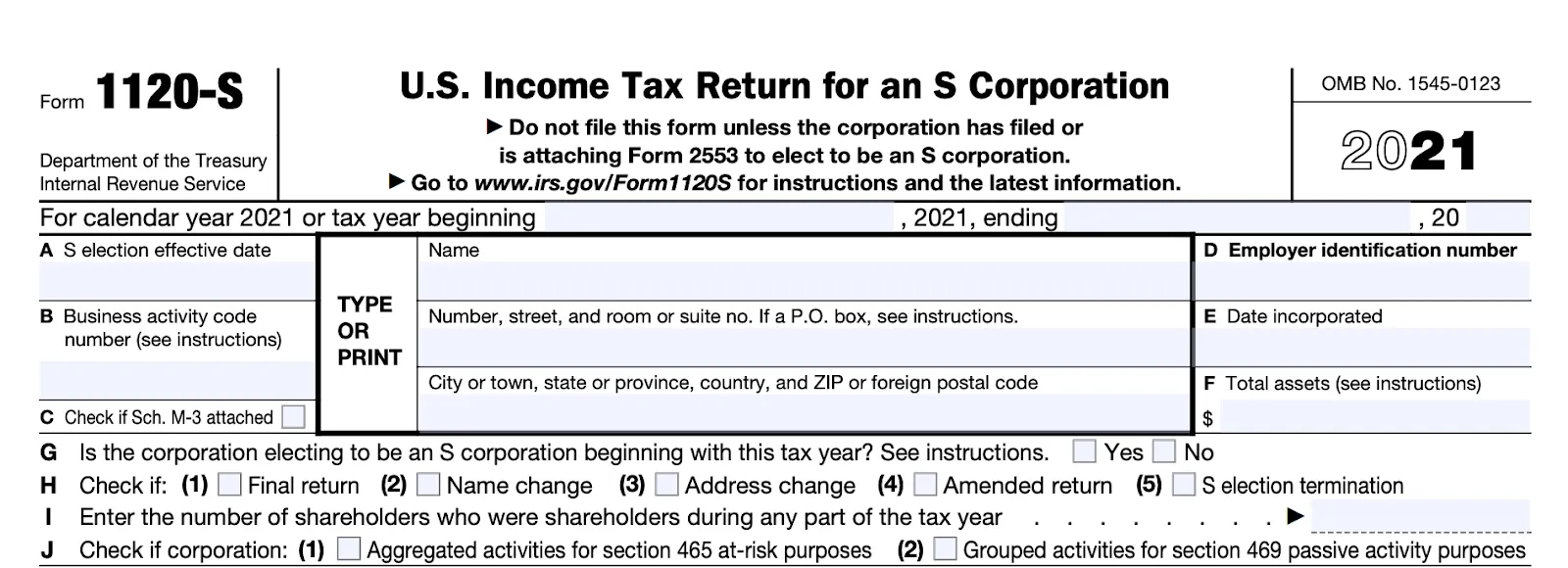
The first section of Form 1120-S is where you provide basic information about your business. In the outlined area, that includes your corporation’s name and address.
Box A. This is the election date you provided on Form 2553.
Box B. Enter your business activity code. For most therapists, it’s 621330 (“Offices of mental health practitioners (except physicians.)”)
Box C. You can skip this.
Box D. Enter your employer identification number (EIN). Learn more about getting an EIN.
Box E. Provide the date when you first incorporated.
Box F. Enter your total assets at the end of the year, based on your books. If you’re required to complete Schedule L (the balance sheet), use the total from Schedule L, line 15, column (d).
Box G. If your S corporation election takes effect this tax year, check “Yes.” You only attach Form 2553 if you haven’t already filed it, and a Form 2553 filed with the return is generally treated as a late election, so talk to your accountant about late-election relief if that applies to you.
Box H. If you’re making changes to your S corporation—changing its name, shutting down the business, changing your address, making an amendment to a prior return, or ending your S corporation status—you can indicate so here.
Box I. Enter the number of people who were shareholders at any point during the tax year. If you’re the only owner of your S corporation, enter 1.
Box J. This section is not relevant to most therapy practices, and you can skip it unless your accountant tells you otherwise.
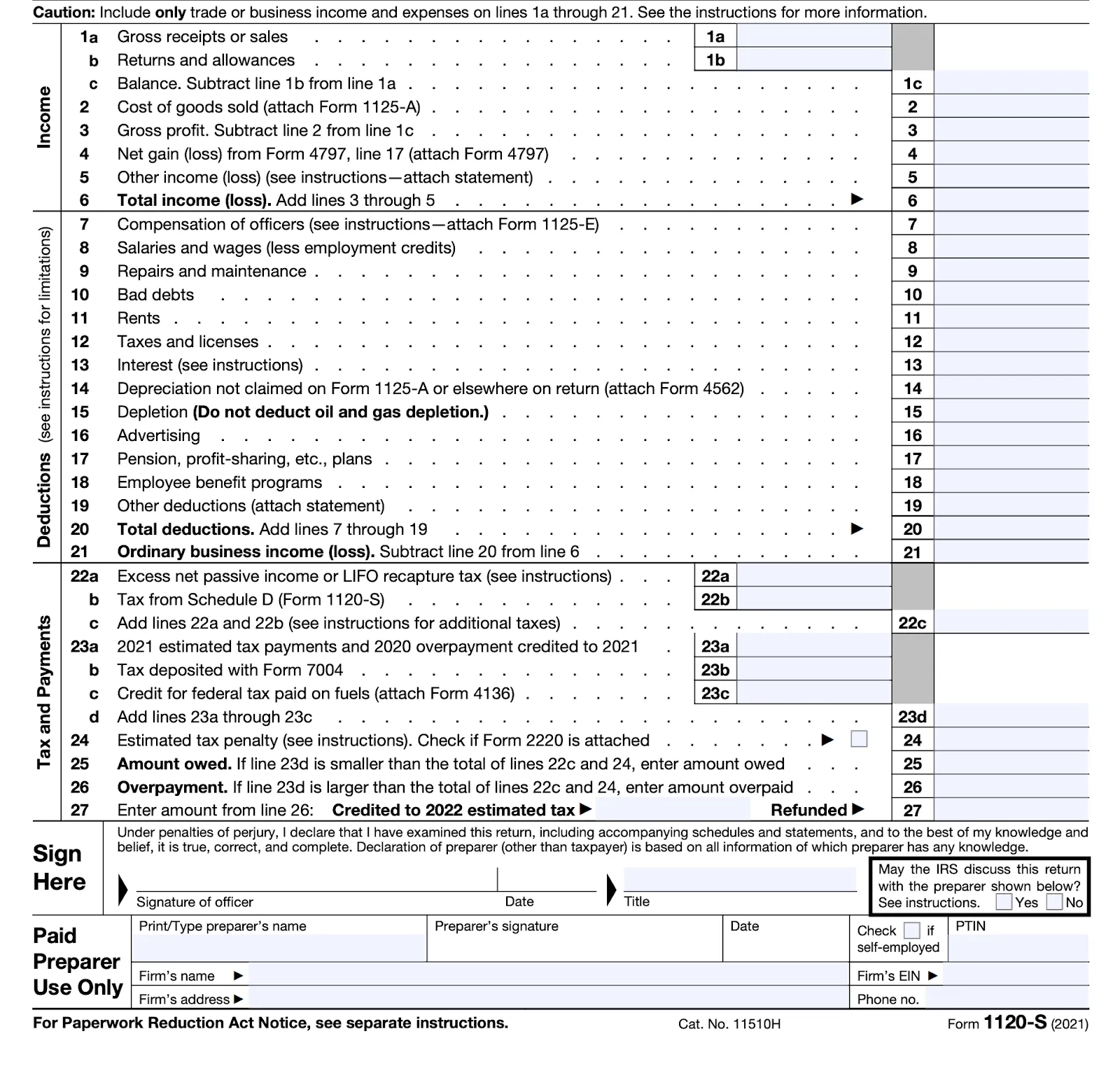
The rest of the first part of Form 1120-S is where you provide information on your income and expenses for the year, as well as tax payments you’ve made during the course of the year.
If you use Heard, this is where you’ll enter your business’s Profit & Loss.
Be sure to consult with an accountant or tax advisor before claiming any deductions you’re unsure of.
Lines 1a, 1b, and 1c. On Line 1a you enter everything you’ve earned during the year. You only need to worry about Lines 1b and 1c if you paid out refunds to clients during the year—in which case, you subtract the refunds from the amount in 1a.
Line 2. This line is not relevant to most therapy practices. It’s where you report the cost of goods sold (COGS), the money you spent manufacturing products or stocking your inventory.
Line 3. For the majority of practices, the value on Line 3 will be the same as 1a., since you aren’t subtracting anything on Line 2.
Line 4. If your practice sold business property during the year, such as equipment or furniture you’d been depreciating, the net gain or loss from Form 4797 goes here. This can get complicated and is best handled with help from an accountant.
Line 5. This is where you enter miscellaneous income coming from certain miscellaneous sources, most of which are not relevant to therapy practices. (You can find a complete list in the IRS instructions for Form 1120-S.)
Line 6. You list your total income here. For the majority of therapy practices, this will be the same value entered on Line 1a and Line 3.
Line 7. Here, you enter the total compensation you paid officers of the company. Since you are the only officer, this is the W-2 salary you paid yourself, which needs to be reasonable compensation for your work. Health insurance the practice pays for you as an owner is included here, too (see Line 18).
Line 8. If you have payroll staff, this is where you enter the total amount you paid them, minus any employment credits for which you are eligible.
Line 9. The total cost of any repairs or maintenance done on your office during the course of the year.
Line 10. Business debts that became worthless during the year, such as client balances you couldn’t collect, go here. If your practice uses the cash method of accounting (most do), you generally can’t deduct bad debts, because the unpaid fees were never counted as income in the first place.
Line 11. The total cost of renting your office should be listed here. Don’t include rent for a home you live in. If you see clients from a home office, that’s typically handled by having the S corp reimburse you through an accountable plan, not on this line.
Line 12. Taxes you paid at the state or municipal level over the course of the year, as well as the cost of any licenses (such as business licenses) you had to purchase in order to operate, are deducted here.
Line 13. If you paid interest on money you borrowed to make a purchase relevant to your business, you report it here. Some interest can’t be deducted, such as interest on purchases or rental or investment properties. For more details, see the instructions for Form 1120-S.
Line 14. If you’re claiming depreciation on an expense that doesn’t qualify as COGS, list it here. You’ll need to include more information about the expense and how it’s being depreciated by attaching Form 4562.
Line 15. This line is only relevant to businesses in resource extraction industries.
Line 16. The total cost of advertising your business may include business cards or flyers, online ads, and other marketing efforts.
Line 17. On this line, you can deduct contributions to pension, profit-sharing, and similar retirement plans you provide employees.
Line 18. The cost of employee benefit programs, such as health insurance, for employees who own 2% or less of the practice is deducted here. Health insurance the practice pays for you as an owner with more than 2% of the shares doesn’t go on this line. Instead, it’s included in your W-2 wages (Box 1) and deducted as part of officer compensation on Line 7. You may then be able to claim the self-employed health insurance deduction on Schedule 1 of your personal Form 1040.
Line 19. This line is for the energy efficient commercial buildings deduction (Form 7205). It doesn’t apply to most therapy practices.
Line 20. Here, you list the total value of all deductions that don’t fall into the categories covered in this section. Examples include the cost of utilities, business travel, office supplies, and insurance premiums. (See our complete guide to tax deductions for therapy practices.) Attach a statement itemizing these deductions to Form 1120-S.
Line 21. Add up all the deductions you are reporting in this section to get your total deductions for the year.
Line 22. Subtract your total deductions (Line 21) from your total income (Line 6) to get your ordinary business income (or loss). This amount flows through to Schedule K, line 1, and to Box 1 of your Schedule K-1, and you report it on your personal tax return.
Lines 23a–23c. These lines cover taxes on excess net passive income, LIFO recapture, and built-in gains, which mostly affect companies that were formerly C corporations. They’re not relevant to most therapy practices.
Lines 24a–28. These lines cover tax payments (including any tax deposited with an extension request), estimated tax penalties, and the amount owed or overpaid. Generally, S corporations aren’t expected to owe federal income tax, so most therapy practices leave them blank. You can’t request an extension on this form: to get an automatic six-month extension to file, submit Form 7004 by the original due date of the return.
Get your 2026 taxes handled
Join Heard by December 31 for up to $3,227 in value and an on-time 2026 tax return. Book a free consult to learn more.
Book a free consultSchedule B for therapists (Form 1120-S)
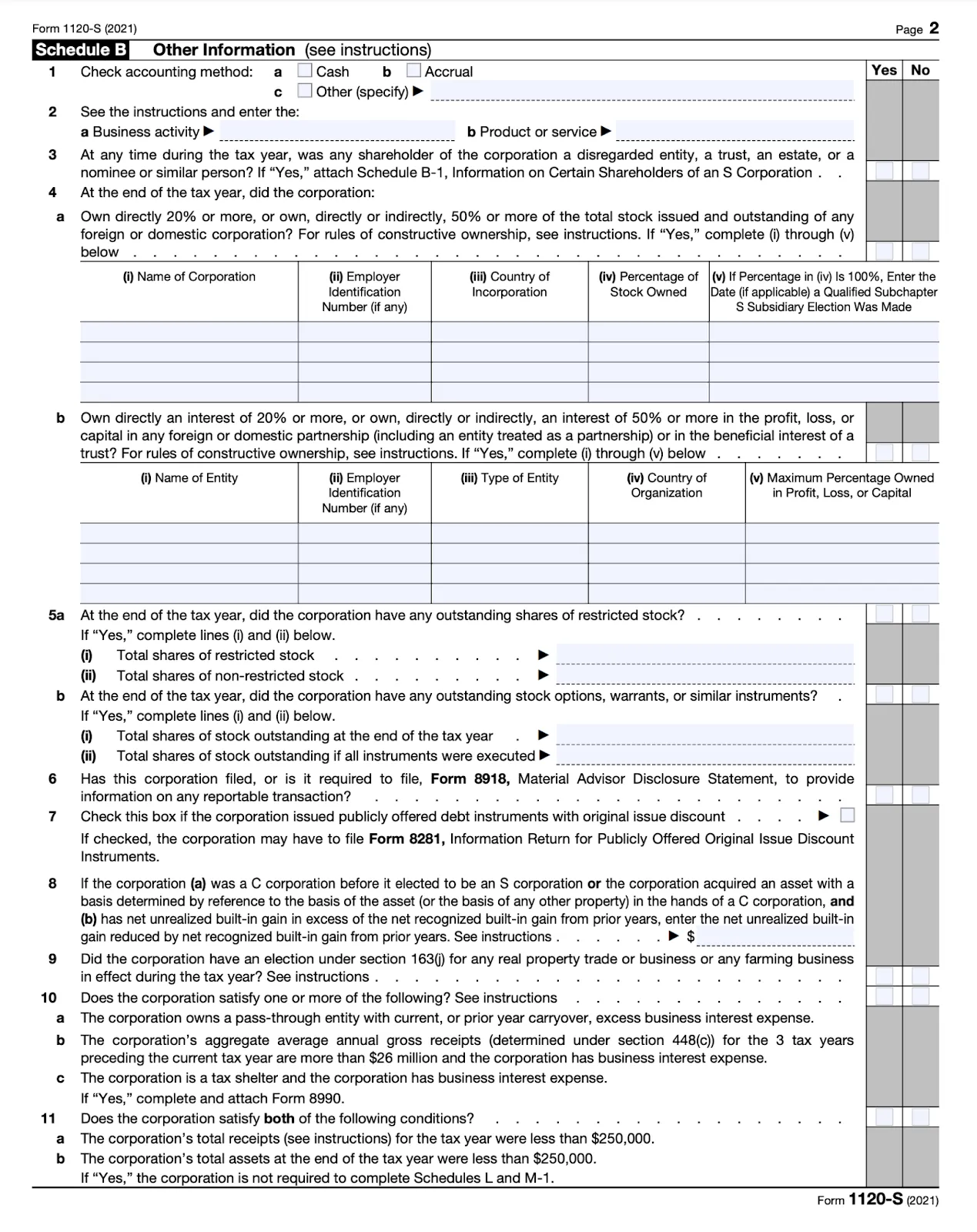
Schedule B begins on page 2 of Form 1120-S, continuing to the beginning of page 3.
For most therapy practices, the majority of Schedule B is not relevant. Lines 3 – 10 have to do with corporations that either own other corporations (entirely; or partially, in the form of shares) or are themselves owned by other corporations (ie. if one of your S corporation members is a business or trust).
Here are the lines every therapy practice needs to fill out:
Line 1. Indicate whether you use accrual accounting or the cash basis method. If you’re not sure, check with your bookkeeper. Our bookkeeping guide for therapists may help as well.
Line 2. Here, you list what your business does, based on IRS categories. For most therapists, the business activity is either “Offices of Mental Health Practitioners (except Physicians)” or “Offices of Physicians, Mental Health Specialists.” For services, you may specify what type of therapy you provide (eg. private counseling, group counseling).
Line 11. If your practice meets both conditions listed here (total receipts for the year of less than $250,000, and total assets at the end of the year of less than $250,000), check “Yes.” You then don’t have to complete Schedule L or Schedule M-1. If it doesn’t (and you check “No”), you’ll need to complete both (covered below).
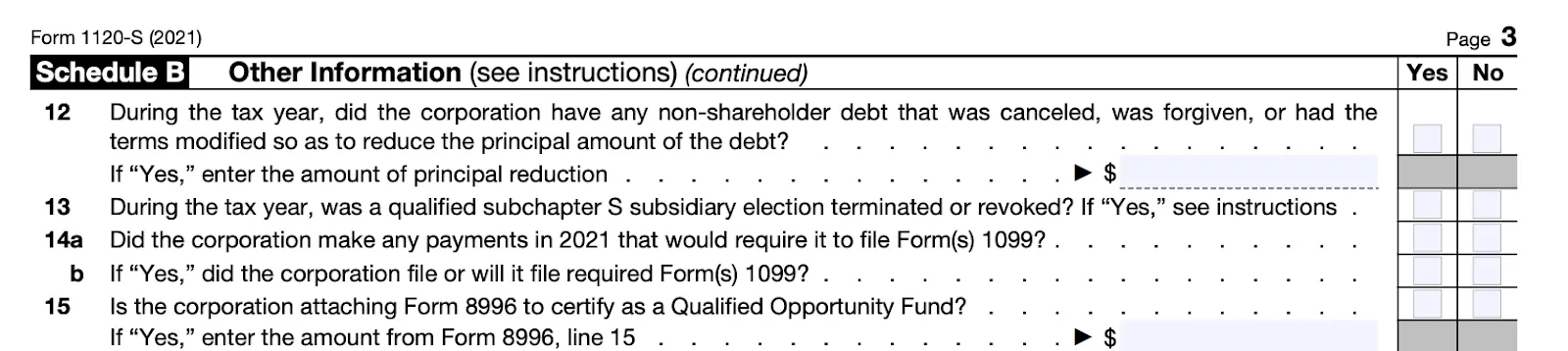
Line 12. If you had any debt canceled or forgiven during the course of the year, or if the terms of any debt you owed changed so that you owed less, mark it here. (Forgiven PPP loans are disregarded for this question.)
Lines 14a and 14b. This is commonly the only “yes” checked off on Schedule B. If you paid a contractor during the course of the year, these lines are relevant. This is where you confirm that your payment qualifies for Form 1099-NEC, and where you confirm to the IRS that you’ll be submitting them Copy A of each Form 1099-NEC you’re filing. If this is new territory for you, check out our guide to hiring independent contractors for your therapy practice.
Schedule K for therapists (Form 1120-S)
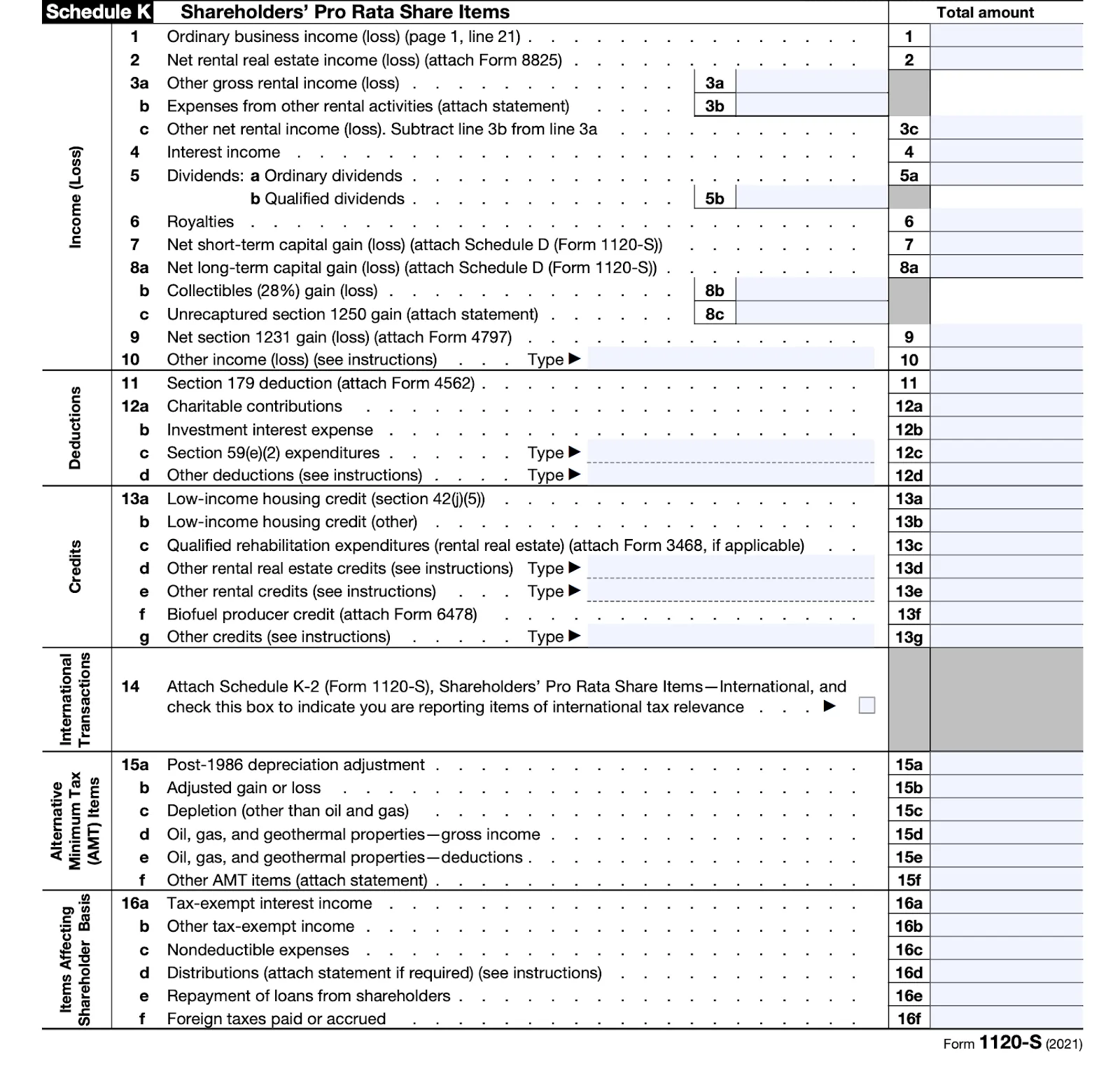
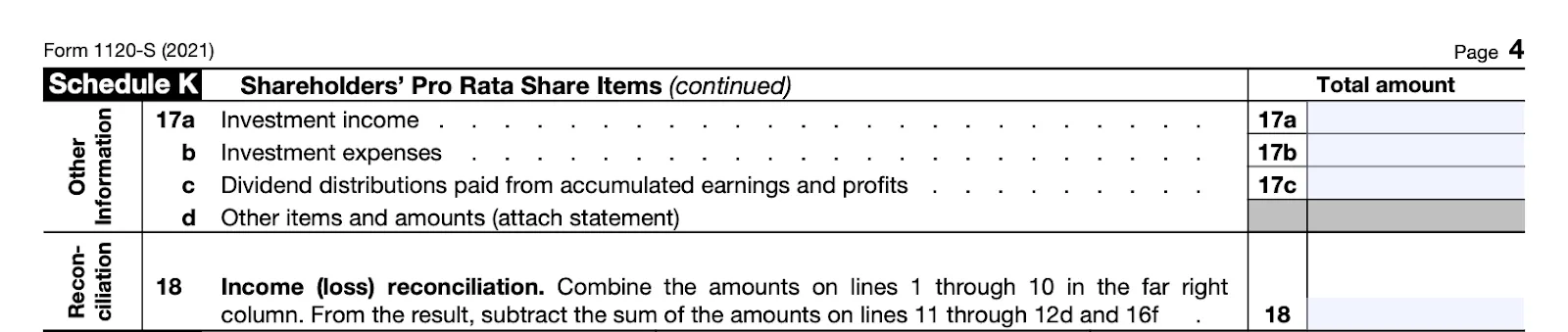
Every Form 1120-S includes Schedule K, but single-member S corporations only need to fill in a few lines.
The lines most practices need are listed below. These will be the same amounts you list on Schedule K-1 for your single-member S corporation.
Line 1. Enter your practice’s ordinary business income (loss) as it is listed on page 1, line 22.
Line 16c. This line is for nondeductible expenses. Pay attention to it if your practice paid for business meals: generally, you can only deduct 50% of the cost of business meals, and the 50% you can’t deduct is listed here. (For 2021 and 2022 only, a temporary enhanced business meal deduction allowed 100% of restaurant meals to be deducted. That rule has expired.)
Line 16d. Enter the total distributions you took from the practice during the year: money paid to you as an owner, separate from your W-2 salary.
Schedule L for therapists (Form 1120-S)
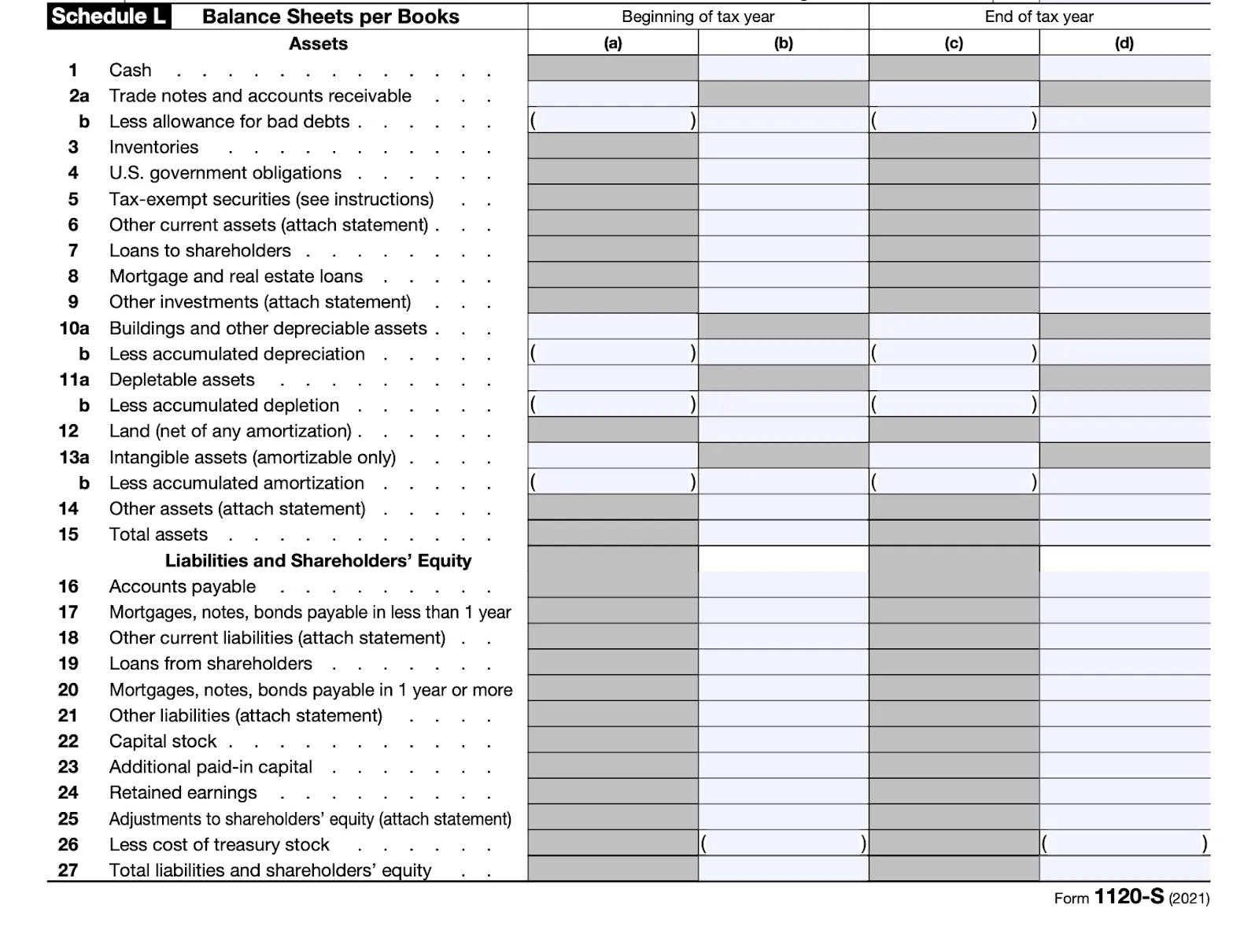
If your business
- Had total receipts of less than $250,000 for the tax year, AND
- Had total assets of less than $250,000 at the end of the tax year,
you can skip Schedule L (and Schedule M-1).
Otherwise, you fill out Schedule L with information from your annual balance sheet. The information you provide won’t affect your deductions or any other part of your tax bill. It’s entered for informational purposes only.
When is Schedule L required on Form 1120-S?
Schedule L is required whenever you answer “No” to Schedule B, Question 11. That happens if your total receipts for the year or your total assets at the end of the year were $250,000 or more. In that case, you also need to complete Schedule M-1, and the total assets figure from Schedule L (line 15, column (d)) goes in Item F on page 1.
“Total receipts” isn’t just client fees. It’s your gross receipts (page 1, line 1a) plus other income reported on lines 4 and 5 and certain income reported on Schedule K. Check both numbers with your bookkeeper before answering “Yes” and skipping Schedule L.
Some S corporations complete Schedule L even when it isn’t required, because keeping a balance sheet makes it easier to reconcile accounts from one year to the next.
Schedule M-1 and Schedule M-2 for therapists (Form 1120-S)
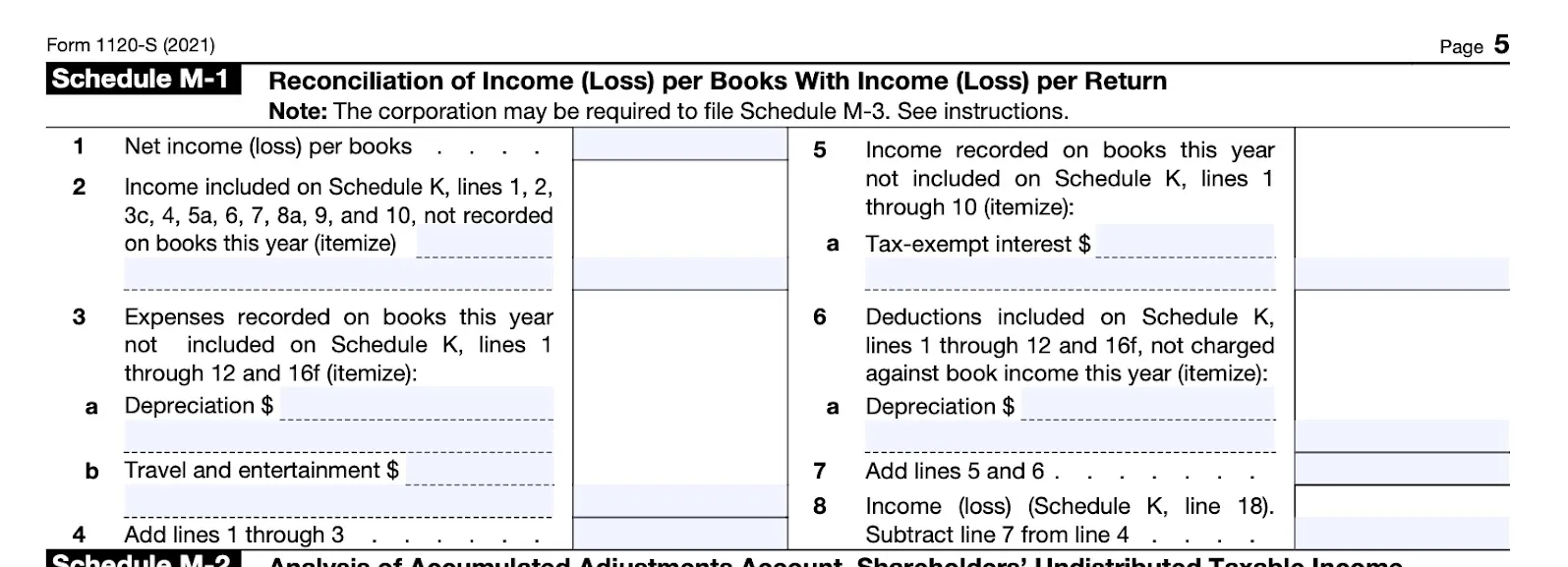
If you answered “Yes” to Schedule B, Question 11, you can skip Schedule M-1. Otherwise, filling out Schedule M-1 of Form 1120-S, you reconcile the difference between your income (and losses) as reported in your books and your income (and losses) as reported on your tax return.
A few ways S corporation income on the books often differs from what’s reported on a tax return:
- Federal tax expense. You report the cost of federal taxes as an expense on the books. You do not report it on your tax return itself.
- Tax exempt income. Some types of income are non-taxable. While that income shows up on the books, it won’t show up on the part of your tax return where you calculate your total taxable income; Schedule M-1 is where you reconcile this difference.
- Meals and entertainment. While 100% of the cost of business meals is entered as an expense on the books, you can generally deduct only 50% of it on your tax return, and entertainment isn’t deductible at all.
- Depreciation deductions. The way you depreciate assets on the books may differ from the way you depreciate them on your tax return.
Once you understand Schedule M-1’s purpose, completing each line item is fairly straightforward. But, if you run up against a wall, get help from your accountant or the team at Heard.
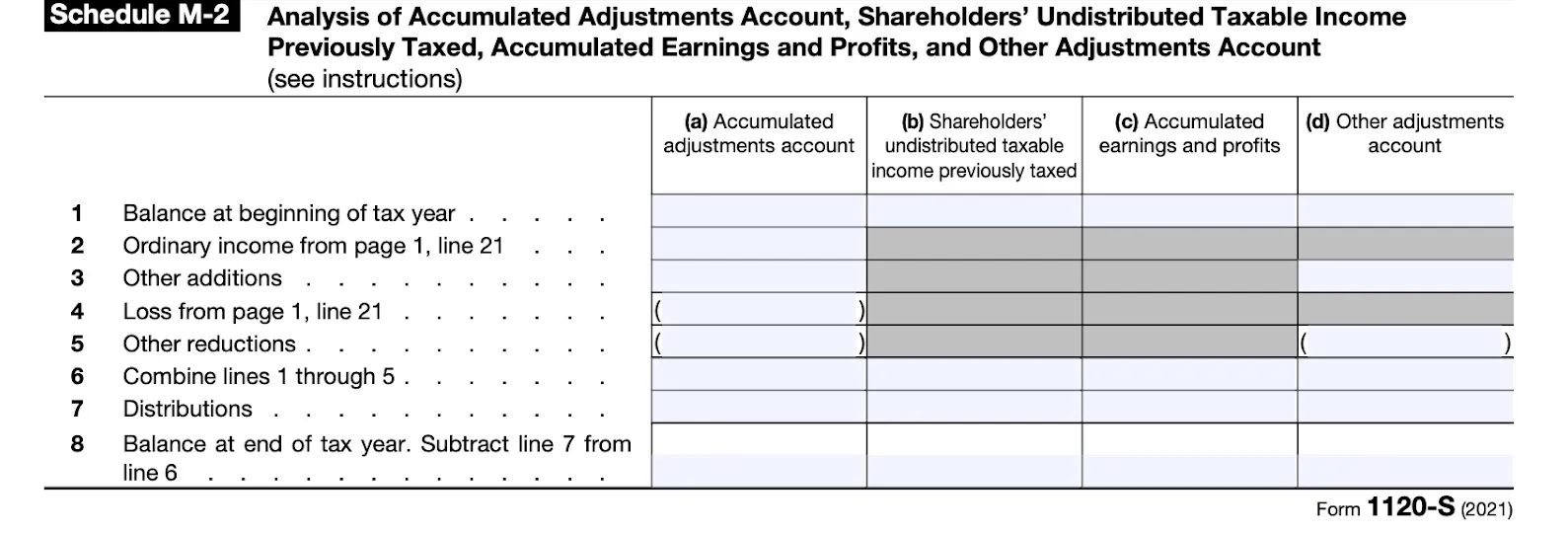
Schedule M-2 of Form 1120-S tracks your S corporation’s equity accounts, most importantly the accumulated adjustments account (AAA). Schedule B, Question 11 doesn’t excuse you from Schedule M-2, and the IRS recommends that every S corporation maintain its AAA.
S corporations pay their owners distributions, not dividends. The AAA generally reflects the practice’s accumulated income that has already been taxed to you but hasn’t been paid out yet. It tracks how much you can generally take out as tax-free distributions (as long as you also have enough basis in your shares).
How to read Schedule M-2 (Form 1120-S)
For a solo practice that has always been an S corporation, you’ll mostly work in column (a), the AAA:
- Line 1: Balance at the beginning of the year (zero in your first S corp year; otherwise, last year’s Line 8).
- Line 2: Ordinary income from page 1, line 22.
- Line 3: Other additions, such as interest income.
- Line 4: Loss from page 1, line 22, if the practice lost money.
- Line 5: Other reductions, such as nondeductible expenses (like the nondeductible half of business meals).
- Line 6: Combine Lines 1 through 5.
- Line 7: Distributions you took during the year. Distributions can’t reduce the AAA below zero.
- Line 8: Balance at the end of the year (Line 6 minus Line 7).
Columns (b) through (d) matter mainly for corporations that were once C corporations or that have tax-exempt income. If it’s your first time completing Schedule M-2, or your AAA hasn’t been tracked in past years, get help from a qualified accountant.
Schedule K-1 for therapists (Form 1120-S)
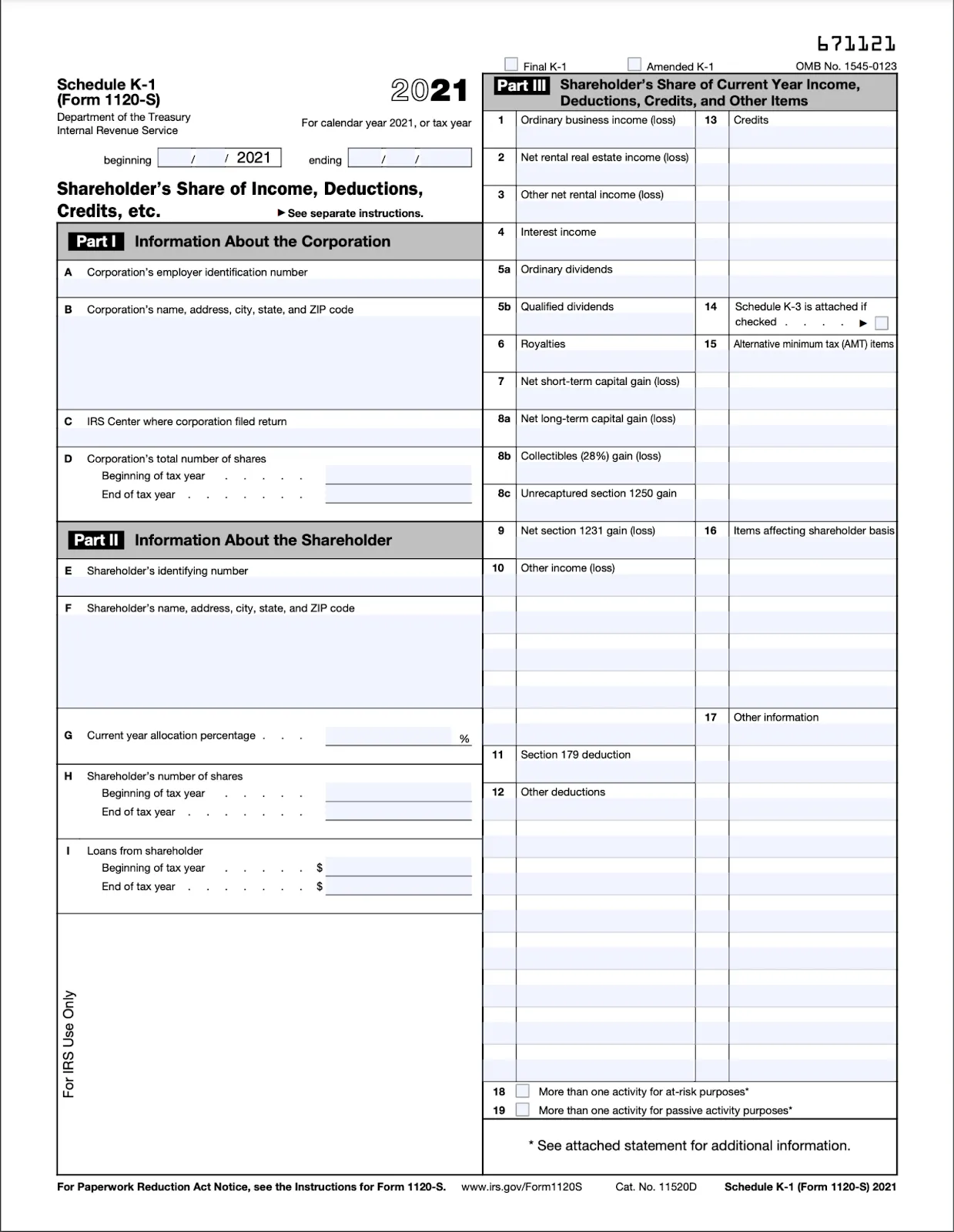
Schedule K-1 reports each shareholder’s share of the S corporation’s income, deductions, credits, and other items, which the shareholder then reports on their personal Form 1040. Even if you’re the only owner, the S corp files a K-1 with its return and gives you a copy. It’s an important part of your S corp tax return, but it’s fairly straightforward, since you own 100% of the company.
Part I. Enter information about your corporation, including its EIN and its total number of shares (Item D), here.
Part II. Enter your personal information here. Since you’re the sole owner, you’ll enter 100% as your current year allocation percentage on Item G, and your number of shares on Item H. Item I is for any money you’ve loaned to the corporation.
Part III.
Box 1. Enter your share of ordinary business income (loss), the same amount as Schedule K, line 1.
Box 16. This box covers items affecting your basis in the company. Report nondeductible expenses, such as the nondeductible 50% of business meals, with code “C,” and distributions you received with code “D.”
Box 17. This box is for other information. Your share of investment income and investment expenses from lines 17a and 17b of Schedule K go here, with codes A and B, respectively. Box 17 is also where the S corp reports the information you need to figure the qualified business income (QBI) deduction (code V), usually on an attached statement.
Example: an S corp tax return for a solo therapy practice
To see how the pieces fit together, here’s a simplified example. Dana is a licensed therapist and the only owner of a fictional practice, Willow Counseling, which has been an S corporation for a few years and uses cash-basis accounting.
| Where | What it means for the practice | Amount |
|---|---|---|
| Form 1120-S, page 1 | ||
| Item F | Total assets at year-end (cash, computer, furniture) | $40,000 |
| Item I | Number of shareholders | 1 |
| Line 1a | Client fees collected | $180,000 |
| Line 7 | Officer compensation: Dana’s W-2 salary, including health insurance premiums the practice paid for her | $70,000 |
| Line 11 | Office rent | $14,400 |
| Line 12 | Taxes and licenses, including the employer share of payroll taxes | $6,500 |
| Line 16 | Advertising | $2,000 |
| Line 20 | Other deductions: EHR software, liability insurance, continuing education, the deductible 50% of business meals | $17,100 |
| Line 21 | Total deductions | $110,000 |
| Line 22 | Ordinary business income | $70,000 |
| Schedule B | ||
| Question 11 | Receipts and assets both under $250,000, so “Yes”: skip Schedules L and M-1 | Yes |
| Schedule K and Schedule K-1 | ||
| K Line 1 / K-1 Box 1 | Ordinary business income | $70,000 |
| K Line 16c / K-1 Box 16, code C | Nondeductible 50% of business meals | $400 |
| K Line 16d / K-1 Box 16, code D | Distributions Dana took during the year | $50,000 |
| Schedule M-2, column (a): accumulated adjustments account | ||
| Line 1 | Balance at beginning of year | $12,000 |
| Line 2 | Ordinary income from page 1, Line 22 | $70,000 |
| Line 5 | Other reductions (nondeductible meals) | ($400) |
| Line 6 | Combine Lines 1 through 5 | $81,600 |
| Line 7 | Distributions | ($50,000) |
| Line 8 | Balance at end of year (next year’s Line 1) | $31,600 |
A few things to notice: Dana’s $70,000 of ordinary business income shows up in four places (page 1, Line 22; Schedule K, line 1; K-1, Box 1; and Schedule M-2, Line 2). Her $50,000 of distributions isn’t a deduction on page 1. It reduces the AAA on Schedule M-2 instead. And because she answered “Yes” to Schedule B, Question 11, her return doesn’t include Schedules L or M-1.
Summary
- Even if your accountant files your taxes, understanding your S corp tax return makes working with them easier.
- Every Form 1120-S includes Schedules B and K, but for most single-member practices, only a few lines of each apply.
- Most single-member practices can skip Schedules L and M-1 by answering “Yes” to Schedule B, Question 11. Schedule M-2 is still completed.
- Schedule M-1 reconciles your books with your return. Schedule M-2 tracks the accumulated adjustments account (AAA) and other equity accounts.
- The S corp must prepare a Schedule K-1 for you even if you’re the only owner.
- Form 1120-S is due by the 15th day of the third month after your tax year ends (March 15 for calendar-year practices, or the next business day). To extend it, file Form 7004 by that same date.
Frequently asked questions
What tax form does an S corp therapy practice file?
S corporations file Form 1120-S, a business return that is separate from your personal Form 1040. Depending on your business, you may also need forms like Form 1125-A or Form 1125-E.
When is Form 1120-S due for a therapy practice?
Form 1120-S is due by the 15th day of the third month after your tax year ends, which is March 15 for calendar-year practices, or the next business day. To get an extension, file Form 7004 by that same date.
Do solo therapy practices need to complete Schedule L and Schedule M-1?
Not always. If your total receipts for the year and your total assets at year end are both under $250,000, you can answer "Yes" to Schedule B, Question 11 and skip Schedules L and M-1, but you still complete Schedule M-2.
Do I need a Schedule K-1 if I'm the only owner of my S corp?
Yes. Even if you're the only owner, the S corp must prepare a Schedule K-1, file it with the return, and give you a copy. It reports your share of the practice's income, deductions, and other items for your personal Form 1040.
Where does my salary from my S corp go on Form 1120-S?
As the only officer, the W-2 salary you pay yourself goes on Line 7 as compensation of officers, and it needs to be reasonable compensation for your work. Health insurance the practice pays for you as an owner is included there too.
—
If your S corporation therapy practice has more than one shareholder, it’s time to get help from an accountant. Learn more about how to hire an accountant for your therapy practice.
This post is to be used for informational purposes only and does not constitute legal, business, or tax advice. Each person should consult their own attorney, business advisor, or tax advisor with respect to matters referenced in this post.
Bryce Warnes is a West Coast writer specializing in small business finances.
Discover more. Get our newsletter.
Get free articles, guides, and tools developed by our experts to help you understand and manage your private practice finances.
Thank you for signing up. Keep an eye out for your first newsletter arriving soon!