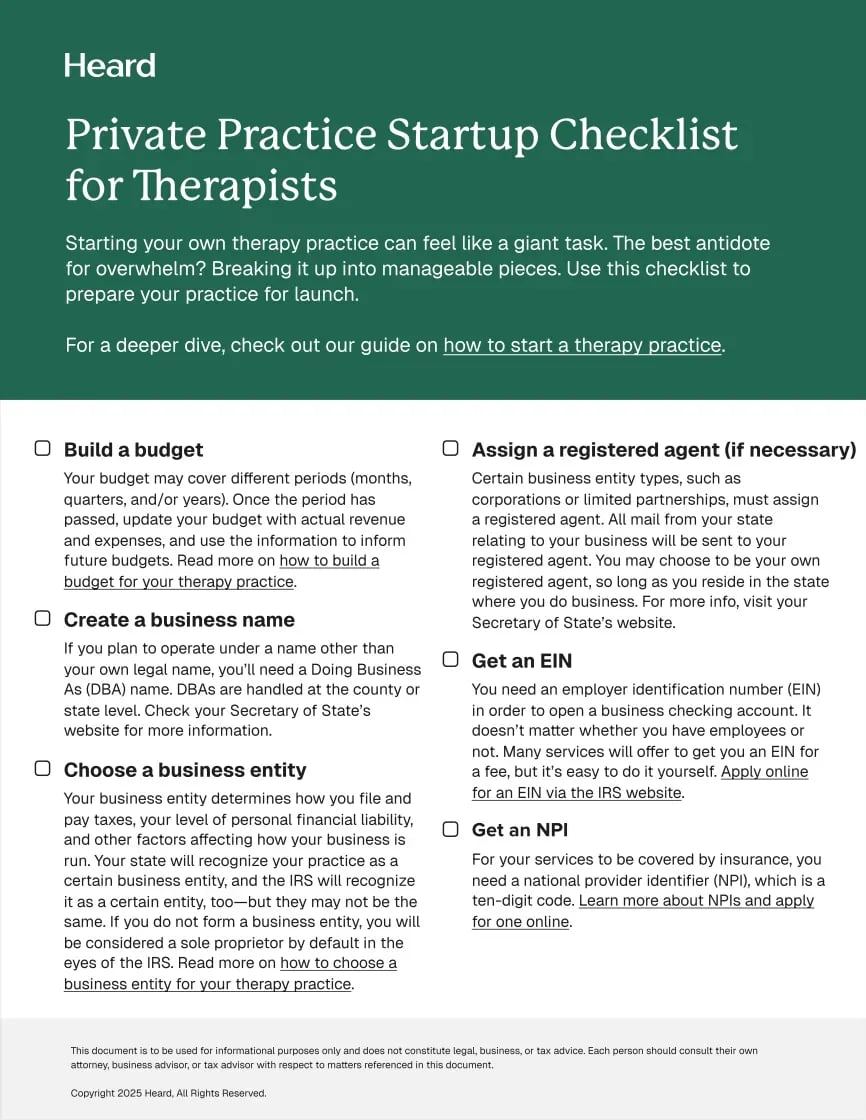

To start a therapy practice in Oregon, follow these steps:
- Confirm your Oregon license allows independent practice
- Check local zoning regulations
- Register a business name
- Choose a business structure
- Register your business
- Obtain relevant licenses and local tax accounts
- Get insurance
- Open a business bank account
- Register as an employer (if you hire)
- Get credentialed with insurers, the Oregon Health Plan, and Medicare (optional)
- Start paying taxes
If you’re moving your practice from a different state, there’s an extra step you’ll need to follow: Figuring out how to pay taxes in multiple states.
This article covers the bare essentials needed to get your therapy practice up and running in the Beaver State, plus a realistic timeline and cost breakdown. For advice on budgeting, marketing your practice, and billing your clients, check out our general guide, How to Start a Therapy Practice.
Starting a therapy practice?
You don't have to do it alone. Every therapist who joins Heard is supported by a team of accountants and tax pros who specialize in therapy practices. Book a free consult to learn more.
Book a free consultConfirm your Oregon license allows independent practice
Before you set up a business, make sure your license lets you see clients on your own. In Oregon, three boards license most private practice therapists:
- Licensed Professional Counselors (LPCs) and Licensed Marriage and Family Therapists (LMFTs) are licensed by the Oregon Board of Licensed Professional Counselors and Therapists (OBLPCT).
- Licensed Clinical Social Workers (LCSWs) are licensed by the Oregon Board of Licensed Social Workers (BLSW).
- Psychologists are licensed by the Oregon Board of Psychology.
How to become a licensed therapist in Oregon
Each board sets its own path to licensure. In broad strokes:
- LPC or LMFT: A qualifying graduate degree, a passing score on an approved national exam, and at least three years (36 months) of supervised clinical experience that includes at least 1,900 supervised direct client contact hours. LMFT applicants need at least 750 of those hours with couples and families. Most applicants complete this experience as a registered associate.
- LCSW: A master’s degree in social work, the ASWB Clinical exam, and 3,500 hours of supervised post-degree experience, including 2,000 direct client hours. Most applicants complete this experience as a Certified Social Work Associate (CSWA).
- Psychologist: A doctoral degree and supervised experience. Unlicensed psychology residents must practice under a Board-approved resident supervision contract.
Requirements change from time to time, so confirm the current rules with your board before you apply.
Can associates practice privately in Oregon?
Only within tight limits, and the rules differ by board:
- LPC and LMFT associates must practice under a Board-approved associate registration plan. A plan can cover up to three practices, including a private practice, but the associate must practice under supervision until fully licensed. Any changes to supervisors, employment, or practice locations need Board approval first. Business cards, directory listings, and other materials must show the associate title and the supervisor’s name, labeled “supervisor.”
- CSWAs practice under a plan of supervision with an agency. The BLSW says hours earned through an independent practice can’t count toward the LCSW, and a CSWA who opens a private practice still has to follow all CSWA rules.
- Psychology residents must practice under a Board-approved resident supervision contract.
If you’re still an associate, talk to your supervisor and your board before you open (or own) a practice. The rest of this guide assumes you hold a full Oregon license.
Check local zoning regulations in Oregon
Oregon boasts 36 counties and 241 incorporated cities. Before you settle on a location for your therapy practice—even if that location is your own home—you must make sure the local zoning allows you to operate there.
In cases where you aren’t typically allowed to operate a business in a certain area—for instance, a home business in a residential area—you can apply for a zoning variance. A variance is more or less an exception to zoning laws.
For information on whether you need to apply for a variance, what types of zoning your town or city recognizes, and what kind of business you can perform there, contact your local municipality.
Register a business name in Oregon
In Oregon, it costs $50 to register an assumed business name, and the registration renews every two years for another $50. The fastest and easiest way to register your business name is through the Oregon Secretary of State Secure Access System.
If you’re a sole proprietor planning to do business under a name different from your “real and true” name—that is, your personal name as it appears on legal documents—you must register an assumed name. General partnership names must include the names of all partners, or else register an assumed name. The same goes for an LLC or corporation that does business under a name other than its registered legal name.
Before registering a name, check its availability. Assumed business names are registered by county: on your application, you list each county where your business is located or where you have an office or employees. That means it’s possible for multiple businesses with the same name to operate in different counties. If you aren’t ready to file yet, you can reserve a name for $100.
Choose a business structure recognized by the State of Oregon
Each state recognizes—and registers—different business structures (aka “entity types”). Your practice’s business structure affects how its income is taxed and who may own shares of the practice.
In Oregon, the business structures you can choose from are:
- Sole proprietorship
- General partnership
- Limited liability company (LLC)
- Professional corporation (PC)
- Business corporation
- Limited liability partnership (LLP)*
- Limited partnership (LP)
*Oregon limits LLPs to partnerships that provide professional services as defined in state law. Check with your licensing board before forming one.
This list is just an introduction. Before settling on a business structure, talk to your accountant—and, if necessary, a lawyer—for help choosing the right one.
For more information, check out our article How to Choose a Business Entity for Your Therapy Practice.
Sole proprietorship
When you go into business for yourself, you’re considered a sole proprietor by default. As a sole proprietorship, your business is identical with your person: all revenue is your revenue, all losses are your losses.
Sole proprietorships are the simplest form of business structure, but offer nothing in the way of legal or financial protection.
General Partnership (GP)
In a general partnership, all members are general partners—meaning, they all share legal and financial liability equally. Because partners can be on the hook for each other’s debts and mistakes, most group practices choose a different structure.
Limited Liability Company (LLC)
The LLC business structure offers liability protection similar to a corporation, but with the option to be taxed in different ways. A single-member LLC is taxed like a sole proprietorship by default, and a multi-member LLC is taxed like a partnership. Your accountant may recommend you elect to be taxed as an S corporation once your practice is profitable enough.
Can therapists in Oregon form a PLLC?
No. Oregon doesn’t have a separate professional limited liability company (PLLC) structure. Instead, a regular Oregon LLC can provide professional services, including therapy. If it does, its articles of organization must list the professional services it will provide.
Here’s the important part: Oregon law treats LLC members who are professionals the same way it treats shareholders of a professional corporation. That means:
- You’re personally liable for your own professional negligence, and for the work of anyone you directly supervise.
- In a group practice, licensed members can also share some liability for each other’s professional negligence, up to limits set by state law: a per-member limit each calendar year and a total per claim. Those limits started at $300,000 and $2 million and are adjusted for inflation; they’re currently $550,000 and $3.55 million (OAR 160-010-0400). The practice’s malpractice insurance is applied to that shared liability first, and you’re always fully liable for your own work.
In other words, a professional entity doesn’t shield you from your own malpractice. It mainly protects your personal assets from the practice’s ordinary business debts, as long as you keep personal and business finances separate. If you’re forming a group practice, ask an Oregon attorney how these rules apply to you. For a deeper dive, check out LLC vs. PLLC for therapists.
Professional Corporation (PC)
A PC is a corporation formed to provide one or more professional services. It offers the same kind of professional liability rules as an LLC, but with stricter ownership rules: all shareholders must be licensed to provide one of the professional services the corporation offers. A PC can only combine two or more professions if each profession’s licensing board expressly allows it.
Because of these extra formalities, many solo therapists in Oregon choose an LLC instead. Check with your board before forming a PC, especially if you plan to bring in clinicians with different licenses.
Business Corporation
A business corporation is a typical corporation as we know it: It exists separately from its owners, who own shares in it. There are two types: C corporations and S corporations. C corporations may elect S corporation status by filing IRS Form 2553.
C corporations have their income taxed separately from the income of the shareholders. S corporations pass on the tax liability to each shareholder. Most therapy practices that want to be taxed as an S corp form an LLC (or PC) and then make the S corp election, rather than forming a standard business corporation.
S corporation tax status
An S corporation is a tax status, not a business structure. An Oregon LLC, PC, or corporation can elect it by filing IRS Form 2553. S corp status can lower your self-employment taxes, but it adds costs like payroll and a more complex tax return. In Oregon, an S corporation that does business in the state also pays a $150 minimum excise tax each year with Form OR-20-S.
S corp status usually starts to make sense at roughly $80,000–$100,000 in annual profit. For details, check out The Complete S Corp Guide for Private Practice Therapists.
Limited Liability Partnership (LLP)
Unlike a limited partnership, none of the members of an LLP are limited partners. In this case, “limited” refers to the liability assumed by the partnership as a whole in case one of its members is sued for malpractice. In Oregon, LLPs are restricted to partnerships that provide professional services as defined in state law, and the Secretary of State recommends checking with your licensing board before forming one.
Limited Partnership (LP)
A limited partnership offers some liability protection for some of its members. To operate as a limited partnership, at least one individual acts as a general partner, who heads the company and makes major decisions, while at least one other individual acts as a limited partner, who does not.
General partners have unlimited liability—they are personally liable for the partnership’s debts, legal proceedings, and so on. Limited partners are only liable for their controlling share of the partnership. LPs are rare for therapy practices.
Register your therapy practice in Oregon
To register your business in Oregon, you need to do two things:
- File the business registration with the State
- Pay the filing fee. For a complete list of fees, see the Business Registration Fee Schedule.
Every registered entity in Oregon (LLC, corporation, LLP, or LP) must also file an annual report and pay a renewal fee by the anniversary of its original filing. The Secretary of State mails a reminder about 45 days ahead.
Here’s a breakdown for each of the business structures covered above.
Form a sole proprietorship in Oregon
Filing fees: No cost to form, fees apply to register an assumed name
Aside from registering an assumed name, there are no extra steps you need to take in order to form a sole proprietorship in Oregon.
Form a general partnership in Oregon
Filing fees: No cost to form, fees apply to register an assumed name
Aside from registering an assumed name, there are no extra steps you need to take in order to form a general partnership in Oregon. Consider drafting a partnership agreement in order to easily resolve any future disputes between partners.
Register a Limited Liability Company (LLC) in Oregon
Filing fees: $100 to file Articles of Organization, plus $100 for each annual report
- Choose a business name. It must include “limited liability company,” “L.L.C.,” or “LLC.”
- Appoint a registered agent. This can be an individual who lives in Oregon or a business entity authorized to do business in Oregon, with a physical street address in the state (not a mail drop or virtual office). Your registered agent is responsible for receiving all official communications from the State.
- File your Articles of Organization and pay the fee using the Oregon Secretary of State Secure Access System. If your LLC will provide therapy, list that professional service in the articles.
- Draft an operating agreement. You don’t file it with the State, but it should cover how members share profits and make decisions, what happens if a member’s license lapses or is suspended, and buyout terms if a member leaves. This is a good place to get help from an attorney.
- Get an employer identification number (EIN) from the IRS. It’s free, and you’ll need one to open a business bank account.
Incorporate in Oregon (business or professional corporation)
Filing fees: $100 to file Articles of Incorporation, plus $100 for each annual report
- Choose a business name
- Appoint a registered agent with a physical street address in Oregon. They’re responsible for receiving all official communications from the State.
- File your Articles of Incorporation and pay the fee using the Oregon Secretary of State Secure Access System. A professional corporation’s articles name the professional services it will provide.
Once you’ve incorporated in Oregon, you can elect S corporation status by filing IRS Form 2553.
Register a Limited Partnership (LP) in Oregon
Filing fees: $100 to file a Certificate of Limited Partnership, plus $100 for each annual report
- Choose a business name
- Appoint a registered agent with a physical street address in Oregon. They’re responsible for receiving all official communications from the State.
- File a Certificate of Limited Partnership and pay the fee using the Oregon Secretary of State Secure Access System.
- Draft a partnership agreement. This isn’t required by law in the State of Oregon, but it will help you stay organized and settle any disputes between partners.
Register a Limited Liability Partnership (LLP) in Oregon
Filing fees: $100 to file an Application for Registration, plus $100 for each annual renewal
- Form a general partnership and choose a business name
- Appoint a registered agent with a physical street address in Oregon. They’re responsible for receiving all official communications from the State.
- File an Application for Registration as an LLP and pay the fee using the Oregon Secretary of State Secure Access System.
- Draft a partnership agreement. This isn’t required by law in the State of Oregon, but it will help you stay organized and settle any disputes between partners.
Starting a therapy practice?
You don't have to do it alone. Every therapist who joins Heard is supported by a team of accountants and tax pros who specialize in therapy practices. Book a free consult to learn more.
Book a free consultGet business licenses and permits for your therapy practice in Oregon
To operate in Oregon, your therapy practice may require licenses or permits. These are handled at the federal, state, and local levels.
Luckily, therapy practices do not need any special federal permits or licenses to operate in Oregon. And, outside of standard licensure for mental health practitioners, they also do not require permitting or licensing at the state level.
At the local level—meaning your municipality (town, city, etc.), you may be required to purchase a business license to operate. Contact your local permitting office for details.
You can search the licenses administered at the State level using Oregon’s License Directory.
Portland and Multnomah County business taxes
If you practice in Portland or anywhere in Multnomah County, you must register for a business tax account with the City of Portland Revenue Division within 60 days of starting your business. The Revenue Division administers:
- City of Portland Business License Tax: 2.6% of net income. For tax years beginning in 2026, you’re exempt if your total gross receipts are under $75,000.
- Multnomah County Business Income Tax: 2% of net income. You’re exempt if your total gross receipts are under $100,000.
Even if you qualify for an exemption, you still need to file a return to claim it. If you practice elsewhere in Multnomah County (Gresham, for example), you still register, but you owe only the County tax.
There’s also a Metro Supportive Housing Services (SHS) business income tax of 1%, but it only applies to businesses with more than $5 million in gross receipts. Sole proprietors don’t pay it at the business level. Instead, they may owe the SHS personal income tax (see “Prepare to pay taxes in Oregon” below).
Get business insurance for your therapy practice in Oregon
The following types of business insurance are highly recommended for therapy practices operating in Oregon:
- General liability insurance
- Commercial property insurance
- Business income insurance
- Professional liability insurance
- Oregon worker’s compensation insurance
While shopping for insurance, look for a business owner’s policy (BOP). A BOP typically includes the three core types of insurance coverage: general liability, commercial property, and business income.
General liability insurance protects you in case of any damages you cause to someone else’s property or person. Many practices carry at least $1 million in coverage. Your landlord may also require a minimum amount in your lease.
Commercial property insurance protects property your therapy practice owns, like computers, business phones, or office furniture. It also protects the building where you operate, whether owned or rented.
Business income insurance covers you for loss of income due to specific circumstances. These include natural disasters, such as fire or storm damage; and man-made disasters, like theft.
Professional liability insurance covers you in case you are sued for libel or slander, for mishandling patient records, for providing inaccurate advice, or for otherwise causing harm in the process of practicing your profession. Because forming an LLC or PC doesn’t protect you from your own malpractice, this coverage matters no matter which structure you choose. In a group practice, each clinician should have their own policy, and the practice should carry one too. Learn more in Do Therapists Need Professional Liability Insurance?
If you have employees, you’re legally required to cover them with Oregon worker’s compensation insurance. This pays for medical expenses, lost wages, and ongoing care in the event one of your employees is injured on the job.
Open a business bank account
Opening a dedicated business checking account is one of the most important early steps in starting your practice. It keeps your personal and business finances separate-which is essential for clean bookkeeping, accurate tax filing, and maintaining liability protection if you've formed an LLC or PLLC.
Heard Banking* is included with every Heard plan at no extra cost. Open a business checking account directly inside the Heard platform in about 10 minutes-no extra setup required. You'll get a Visa debit card (physical and virtual), and every transaction is automatically categorized based on a chart of accounts designed for private practices, with no manual imports required. No account fees.*** Deposits are FDIC insured up to $3M, and both checking and savings accounts earn up to 2.5% APY.** Learn more about opening a Heard bank account.
Register as an employer in Oregon
If you hire employees, or if you elect S corp status and pay yourself a salary, you’ll need to register as an employer before you issue your first paycheck. You can register for an Oregon business identification number (BIN) through the Department of Revenue’s Revenue Online system, the Oregon Business Registry, or the Combined Employer’s Registration form. Registration also sets you up with the Oregon Employment Department.
Once registered, you’ll report payroll taxes each quarter on Form OQ. As an Oregon employer, you’ll handle:
- Oregon income tax withholding from employees’ wages
- State unemployment insurance tax. For 2026, new employers pay 2.4% on the first $56,700 of each employee’s wages.
- Paid Leave Oregon contributions. For 2026, the total rate is 1% of each employee’s wages up to $184,500. Employers with 25 or more employees pay 40% of that and employees pay 60%. Employers with fewer than 25 employees don’t pay the employer share, but they still withhold and send in the employee share. Self-employed therapists can opt in to coverage.
- Statewide transit tax of 0.1% withheld from employee wages (plus local transit taxes in some areas)
- Workers’ compensation coverage and the Workers’ Benefit Fund assessment
Most private practices use a payroll service to handle all of this. Learn more in Payroll 101 for Private Practice.
Get credentialed with insurers, the Oregon Health Plan, and Medicare
If you plan to accept insurance, start credentialing early. It’s usually the slowest part of opening a practice. (Even if you’re private pay only, you’ll want an NPI so you can give clients superbills.)
Get your NPI numbers
A National Provider Identifier (NPI) identifies you to insurers. A Type 1 NPI identifies you as an individual clinician, and a Type 2 NPI identifies your practice as an organization. You may not need a Type 2 NPI as a solo clinician, but you’ll need one to bill as a group. Both are free through NPPES.
Create a DataSpring (formerly CAQH) profile
Most commercial insurers use DataSpring (formerly CAQH) to collect your credentialing information. Rather than completing a separate application for every insurance panel, you authorize each insurer to view your profile. It’s free to create a profile, and you’ll need to re-attest about every 120 days. For the full process, see The Complete Guide to Insurance Credentialing for Therapists.
Enroll in the Oregon Health Plan (Medicaid)
The Oregon Health Plan (OHP) is Oregon’s Medicaid program. Most OHP members get their care through regional coordinated care organizations (CCOs), so there are two separate pieces:
- Enroll with the Oregon Health Authority. You need an NPI first. Individual clinicians who bill for their own services enroll as a “payable individual,” and group practices enroll as an organization using OHA forms 3972, 3974, and 3975. The Oregon Health Authority prefers online submission through the MMIS Provider Portal. See OHP provider enrollment for current forms. You’ll need to revalidate at least every five years.
- Contract with each CCO that serves your clients. CCO enrollment and credentialing are separate from state enrollment, and each CCO has its own process. Contact the CCOs in your area directly.
Enroll in Medicare through PECOS
Licensed marriage and family therapists and licensed professional counselors can now bill Medicare as mental health counselors (MHCs) or MFTs. To qualify, you need two years or 3,000 hours of post-degree supervised clinical experience. You enroll through the federal PECOS system as an individual, and, if you have a group practice, enroll the group and reassign your benefits to it. Don’t bill Medicare until your enrollment is approved.
Prepare to pay taxes in Oregon
Every business earning income in Oregon is required to pay state taxes. Oregon has no general sales tax, so you won’t collect sales tax from clients. Here’s what you will pay.
Oregon personal income tax
If you’re a sole proprietor, or your LLC or S corp passes income through to you, your practice’s profit is taxed on your personal Oregon return. Oregon’s income tax rates range from 4.75% to 9.9%. The top 9.9% rate applies to taxable income over $125,000 for single filers ($250,000 for joint filers). The lower brackets are adjusted for inflation each year, so check the Oregon Department of Revenue for the current rate charts.
If you expect to owe $1,000 or more in Oregon tax after credits and withholding, you’re required to make quarterly estimated payments.
Wondering how to get started? Check out How to Pay Income Tax in Every State as a Therapist.
Portland-area personal income taxes
If you live or earn income in the Portland area, you may owe two local income taxes on top of Oregon’s:
- Metro Supportive Housing Services (SHS) tax: 1% of taxable income above $125,000 for single filers ($200,000 for joint filers), for residents of the Metro district and nonresidents with income from inside it. Starting with tax year 2026, these thresholds are adjusted each year for inflation.
- Multnomah County Preschool for All (PFA) tax: 1.5% of taxable income above $125,000 for single filers ($200,000 for joint filers), plus an additional 1.5% on income above $250,000 ($400,000 joint). A scheduled 0.8% rate increase has been delayed to January 1, 2028.
Starting with tax year 2026, you need to make quarterly estimated payments for either tax if you expect to owe more than $5,000 for it.
Oregon Corporate Activity Tax (CAT)
Despite the name, the Corporate Activity Tax can apply to any business type, including sole proprietors and LLCs. Most solo practices won’t owe it. You must register within 30 days of reaching $750,000 in Oregon commercial activity for the year, and you only owe tax if you have more than $1 million in taxable Oregon commercial activity. The tax is $250 plus 0.57% of taxable commercial activity over $1 million, after a subtraction for certain costs.
S corporation minimum tax
If you elect S corp status, your S corporation files Form OR-20-S each year and pays at least the $150 Oregon minimum excise tax. This tax is paid by the S corporation and doesn’t pass through to you.
Learn how to pay taxes in multiple states
If you started your therapy practice in a different state, and you’re moving to Oregon—or if you operate in Oregon, and you’re planning to move to a different state—you’ll need to figure out how to pay taxes in multiple states.
The rules vary depending on which states you operate in over the course of the year, and how long you spend in each. Check out how moving to a different state impacts your taxes as a therapist.
How long does it take to start a therapy practice in Oregon?
If you’re already fully licensed, plan on two to four weeks to form your business and set up your back office before you see clients. Oregon’s online business filings are quick. Most of your time goes into your operating agreement, insurance, banking, and systems.
If you plan to accept insurance, OHP, or Medicare, add a few months for credentialing and enrollment. You can start seeing private-pay clients while you wait.
| Step | Typical time | Notes |
|---|---|---|
| Get an EIN | Same day | Free online from the IRS |
| Check name and file with the Secretary of State | A few business days | File online for the fastest processing |
| Draft operating or partnership agreement | 1 to 2 weeks | Can take longer if an attorney drafts it |
| Bank account, insurance, EHR, bookkeeping | 2 to 4 weeks | Can run in parallel with other steps |
| Employer registration (if you have payroll) | Up to 30 business days online | Register before your first paycheck |
| Insurance panels, OHP, CCOs, and Medicare | Several months | Timelines vary by payer; start early |
How much does it cost to start a therapy practice in Oregon?
Oregon’s state filing fees are low. Forming an LLC costs $100, and keeping it active costs $100 a year. Your bigger costs are usually legal help, insurance, and software.
| Cost item | Cost | Notes |
|---|---|---|
| LLC Articles of Organization | $100 | One-time state filing fee |
| Corporation (business or professional) Articles of Incorporation | $100 | One-time state filing fee |
| Annual report (LLC, corporation, LLP, or LP) | $100 per year | Due by the anniversary of your original filing |
| Assumed business name | $50 | Renews every two years for $50 |
| Name reservation (optional) | $100 | Only if you want to hold a name before filing |
| EIN and NPI numbers | Free | Through the IRS and NPPES |
| DataSpring (formerly CAQH) profile | Free | Re-attest about every 120 days |
| Attorney help with formation and operating agreement | Varies widely | Optional, but worth it for group practices |
| Malpractice insurance | Varies | Annual premium depends on license, coverage limits, and history |
| Portland business tax registration | No fee to register | Taxes owed depend on your net income and gross receipts |
| Oregon S corp minimum tax (if you elect S status) | $150 per year | Paid by the S corporation with Form OR-20-S |
This breakdown doesn’t include ongoing costs like payroll, an EHR, or S corp tax prep. For more, see How Much Does It Cost to Start a Therapy Practice?
How much do therapists make in Oregon?
According to the U.S. Bureau of Labor Statistics (May 2025), the average annual wage in Oregon was about:
- $75,540 for substance abuse, behavioral disorder, and mental health counselors (median $74,590)
- $102,390 for marriage and family therapists (median $91,520)
- $73,050 for mental health and substance abuse social workers
- $129,590 for clinical and counseling psychologists
These figures cover employed clinicians, not practice owners. In private practice, your take-home pay depends on your rates, caseload, payer mix, and expenses. To estimate yours, see How to Pay Yourself as a Therapist.
Frequently asked questions
What are the steps to start a therapy practice in Oregon?
Confirm your license allows independent practice, check local zoning, register a business name, choose a business structure, register your business, get any licenses and local tax accounts you need, get insurance, open a business bank account, register as an employer if you hire, get credentialed if you’ll take insurance, and start paying taxes. If you're moving your practice from another state, you'll also need to figure out paying taxes in multiple states.
How much does it cost to register a business name in Oregon?
It costs $50 to register an assumed business name in Oregon, and the registration renews every two years for $50. The easiest way to register is through the Oregon Secretary of State Secure Access System. You list each county where your business is located on the application.
How much does it cost to form an LLC or corporation for a therapy practice in Oregon?
Filing Articles of Organization for an LLC or Articles of Incorporation for a corporation costs $100, and the annual report costs $100 a year. You'll also need a registered agent with a physical street address in Oregon.
Can therapists form a PLLC in Oregon?
No. Oregon doesn’t have a PLLC structure. A regular Oregon LLC can provide professional services, and its articles must list the services it provides. LLC members who are professionals are liable the same way professional corporation shareholders are, so the LLC won’t protect you from your own malpractice.
Can associates open a private practice in Oregon?
Not independently. LPC and LMFT associates must practice under a Board-approved associate registration plan, which can include a private practice setting, and must stay under supervision until fully licensed. CSWAs practice under a plan of supervision with an agency, and hours from an independent practice don’t count toward the LCSW. Check with your board before opening a practice.
Do therapists need a business license in Oregon?
Therapy practices don't need special federal permits, and beyond standard licensure for mental health practitioners, they don't need state permits either. Your town or city may require a local business license, so check with your local permitting office. In Portland and Multnomah County, you must register for a business tax account within 60 days of starting.
Does Oregon have a sales tax?
No. Oregon has no general sales tax, so you don’t collect sales tax on therapy services. You will pay Oregon income tax on your practice’s profit, and possibly local income taxes if you live or work in the Portland area.
What business insurance do therapists need in Oregon?
General liability, commercial property, business income, and professional liability insurance are highly recommended. Many practices carry at least $1 million in general liability coverage. If you have employees, you must carry Oregon workers' compensation insurance.
—
Want to learn more? Check out our guide on how to start a therapy practice.
This post is to be used for informational purposes only and does not constitute legal, business, or tax advice. Each person should consult their own attorney, business advisor, or tax advisor with respect to matters referenced in this post.
* Heard Banking is a financial technology company, not a bank. Banking services provided by i3 Bank, Member FDIC. Banking technology powered by Unit Finance, Inc. The Heard Visa Debit Card is issued by i3 Bank pursuant to a license from Visa U.S.A. Inc. and may be used everywhere Visa debit cards are accepted. Deposits may be eligible for up to $3 million of FDIC insurance through a network of participating banks. Each participating bank is FDIC insured up to $250,000 per depositor, per bank. Accounts are eligible for pass-through deposit insurance only to the extent pass-through insurance is permitted by the rules and regulations of the FDIC, and if the requirements for pass-through insurance are satisfied.
** Annual Percentage Yield (APY) is variable and subject to change after account opening. Rate is compounded monthly and credited monthly.
*** No account or domestic transaction fees. Some foreign transaction fees may apply in limited circumstances.
Bryce Warnes is a West Coast writer specializing in small business finances.