

Whether you do your own bookkeeping and accounting, or whether you have the experts at Heard handle it for you, here are the key terms you need to understand when it comes to private practice finances.
- Accounting
A broad term that encompasses tax prep and filing, financial reports, financial projections, and high-level management of finances. An accountant uses your bookkeeping data to produce financial reports that show how your practice is performing. They use those financial reports to prepare your tax return.
Accrual accounting
One of two accounting methods. (The other is cash basis accounting.) When you use the accrual method, you record transactions each time your business earns or spends money, even if the money hasn’t changed hands yet. Money you earn is recorded under Accounts Receivable; money you spend is recorded under Accounts Payable.
- Asset
Anything of value your practice owns. An asset may be tangible (physical) or intangible (non-physical). Common examples of tangible assets include therapeutic equipment (eg. gait trainers used by occupational therapists), office furniture, and work vehicles. Intangible assets include your practice’s brand name, business contracts, and reputation.
- Balance sheet
One of three key financial statements, the balance sheet reports all of your practice’s assets and liabilities up to a particular date. Along with the profit and loss statement (P&L) and cash flow statement (in the case of practices using the accrual method of accounting), the balance sheet paints a picture of how your practice is performing financially.
- Bookkeeping
The practice of recording and categorizing day-to-day transactions for your practice. Each time you earn or spend money, the transaction is recorded as part of the bookkeeping process. That data—stored in a document called the general ledger—is then used to prepare financial statements.
Cash basis accounting
One of two accounting methods. (The other is accrual accounting.) Using the cash basis method, you record revenue and expenses when cash changes hands, not when the transactions occur.
- Cash flow
The informal definition of cash flow is the rate at which cash comes into your business as revenue. The precise, technical definition of cash flow is how quickly Accounts Receivable (under the accrual method) converts from money owed to your practice to money actually received by it. This type of cash flow is tracked using the cash flow statement.
- Cash flow statement
Only businesses using the accrual method of accounting require cash flow statements. A cash flow statement reconciles earning and spending reported in the P&L (based on transactions in the general ledger) with actual cash in hand. Comparing your cash flow statement with your P&L allows you to measure *cash flow—*how quickly Accounts Receivable and Accounts Payable convert to tangible assets and liabilities in the form of cash.
Chart of accounts
A bookkeeping account—sometimes called a ledger—is a category under which revenue or expenses are recorded. Your chart of accounts lists and defines every one of these categories. Your bookkeeper refers to it when categorizing transactions.
- Deductible expense
A business expense you may deduct from your taxable income. An expense may be fully deductible (you deduct 100% of it) or partially deductible (you deduct a portion of it). The ability to track deductible expenses and reduce your tax burden is part of what makes bookkeeping an important tool for businesses. (Learn more about deductions for your private practice.)
- Double-entry bookkeeping
The international business standard for bookkeeping. With double entry, each transaction appears twice: Once, for cash going into account, and again for cash leaving a different account. Double entry helps to protect against bookkeeping errors.
Employer insurance number (EIN)
A tax identification number used by the IRS to track your business. Even if your practice does not have any employees, you need an EIN in order to open a business bank account or register a limited liability company (LLC). Learn how to get an EIN for your practice.
Financial projection
A model of what your practice’s finances could look like under different future scenarios. Financial projections are generated based on past bookkeeping data and financial reports. You can use financial projections to inform your business decisions.
- Financial report
A summary of your business activities and current assets and liabilities. There are three key financial reports:
- The profit and loss statement (P&L)
- The balance sheet
- The cash flow statement (used only in accrual accounting)
Your bookkeeper or accountant generates financial reports based on bookkeeping data in your general ledger.
General ledger
The document at the heart of your practice’s bookkeeping. It records every business transaction and categorizes it based on your chart of accounts.
- Liability
Money your business must pay. This may take the form of debt, bills, or taxes owed. Liabilities are reported alongside your assets on your balance sheet
- Limited liability company (LLC)
A business entity formed at the state level by filing articles of organization with your Secretary of State. True to its name, an LLC gives you added liability protection, allowing you to legally separate your person and your business and protect your personal assets. While an LLC is recognized only at the state level, it can elect to be taxed as a number of different entities, including a disregarded entity (equivalent to a sole proprietor), a partnership, or an S corporation.
- Owner’s draw
Money you pay yourself from your practice’s earnings. Owner’s draws are typically taken by sole proprietors. Other business entities, including S corporations, require you to pay yourself a salary.
- Pass-through entity
A business entity whose revenue and expenses are “passed through” to shareholders or partners, and reported on their personal tax returns. Contrast this with a C corporation, which is taxed as a separate entity. Sole proprietorships, partnerships, and S corporations are all types of pass-through entities.
- Payroll tax
Money withheld from an employee’s salary in order to pay Federal Insurance and Contributions Act (FICA) tax. The total amount of FICA is 15.3% of the employee’s earnings, with half of the payment withheld from their pay and the other half contributed by their employer. Self-employed practice owners must pay an equivalent amount in self-employment tax.
- Profit and loss statement (P&L)
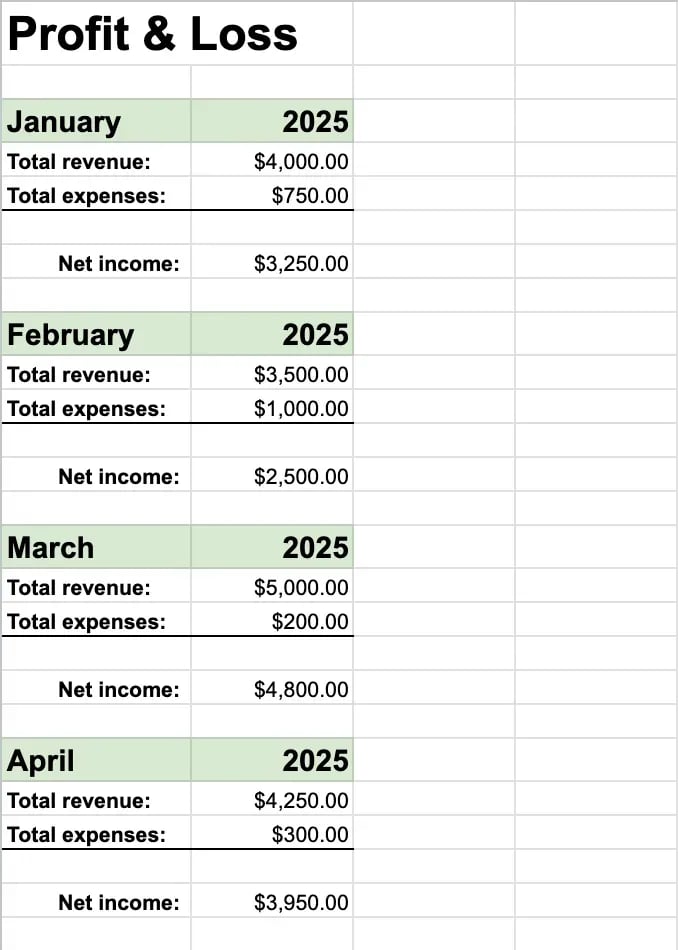
Sometimes called the income statement. A P&L tells you how much you earned (revenue) and how much you spent (expenses) over a particular period. Subtracting expenses from revenue gives you your net income. It’s typical to generate P&Ls on a monthly or quarterly basis. An annual P&L, covering the entire year, gives you the information you need to file your tax return. Like the balance sheet, the P&L is based on data recorded in your general ledger.
- Qualified business income (QBI) deduction
The QBI deduction allows qualifying businesses to deduct up to 20% of their gross income for the year from their taxes. Most private practices partially or fully qualify for this deduction. Learn more about the QBI deduction.
- Quarterly estimated taxes
If your practice owes $1,000 in federal taxes for the year, you must file quarterly estimated taxes. In effect, you pay your tax bill over the course of the year in four installments, based on your total estimated income.
S corporation
An elected tax status that allows your practice to operate similarly to a corporation, but while remaining a pass-through entity. Your practice must first register as an LLC before electing S corporation status. S corp status confers tax benefits—by electing it, you may be able to reduce the amount of self-employment tax you pay each year.
Sole proprietor
Once you start earning self-employment income, the IRS considers you a sole proprietor. For tax and legal purposes, your person and your business are identical. You report your business revenue and expenses on Schedule C of Form 1040.
Self-employment tax
The equivalent to payroll tax, paid by self-employed individuals. The total amount is 15.3% of the individual’s taxable income.
Frequently asked questions
What's the difference between bookkeeping and accounting for a therapy practice?
Bookkeeping is recording and categorizing your practice's day-to-day transactions in the general ledger. Accounting is broader: an accountant uses your bookkeeping data to produce financial reports and projections, and uses those reports to prepare your tax return.
What's the difference between cash basis and accrual accounting?
With cash basis accounting, you record revenue and expenses when cash actually changes hands. With accrual accounting, you record them when your practice earns or spends the money, even if it hasn't been paid yet, using Accounts Receivable and Accounts Payable.
What are the three key financial reports for a therapy practice?
They're the profit and loss statement (P&L), the balance sheet, and the cash flow statement. The cash flow statement is only used by practices on the accrual method of accounting.
Do therapists need an EIN if they don't have employees?
Yes, in many cases. Even without employees, you need an EIN to open a business bank account or register an LLC. The IRS uses it to track your business.
What's the difference between an owner's draw and a salary?
An owner's draw is money you pay yourself from your practice's earnings, and it's typically taken by sole proprietors. Other business entities, including S corporations, require you to pay yourself a salary.
—
Want to lower your tax bill? Our guide to the most valuable write-offs for therapists is the place to start.
This post is to be used for informational purposes only and does not constitute legal, business, or tax advice. Each person should consult their own attorney, business advisor, or tax advisor with respect to matters referenced in this post.
Bryce Warnes is a West Coast writer specializing in small business finances.
Discover more. Get our newsletter.
Get free articles, guides, and tools developed by our experts to help you understand and manage your private practice finances.
Thank you for signing up. Keep an eye out for your first newsletter arriving soon!